
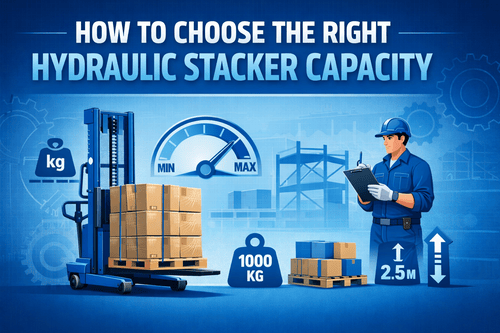
To choose the right hydraulic stacker capacity, calculate your heaviest load weight, add a 20% safety margin, and match it with a stacker rated above that total. Always consider the load’s size and your lifting height needs.
Selecting the right hydraulic stacker for your warehouse or factory isn’t rocket science, but it does require some careful thought. Think of it like buying a vehicle – you wouldn’t use a small car to move furniture, right? The same logic applies to material handling equipment.
Understanding What Capacity Really Means
When we talk about capacity, we’re simply referring to how much weight your hydraulic stacker can safely lift. Most stackers come with capacity ratings ranging from 1 ton to 3 tons, though some heavy-duty models can handle even more.
The capacity isn’t just a number on a spec sheet – it’s your safety guarantee. Overloading a stacker is like stuffing too many people in an elevator. Something’s eventually going to give, and when it does, it could mean damaged goods, broken equipment, or worse, workplace injuries.
Step 1: Know Your Loads
Start by walking through your warehouse and making a list. What’s the heaviest pallet you move regularly? What about those occasional shipments that come in?
Grab a weighing scale and actually measure. Don’t guess. That stack of boxes might look light, but appearances can be deceiving. I’ve seen warehouse managers surprised to discover their “light” loads were actually pushing 800 kilograms.
Write down:
- Your average daily load weight
- Your heaviest regular load
- Any special or seasonal heavy items
Step 2: Add a Safety Buffer
Here’s a golden rule: never buy a hydraulic stacker that matches your exact maximum load. Always go higher.
Why? Because real-world conditions aren’t perfect. Pallets might be unevenly loaded. Weights can vary. Equipment performance changes slightly over time. A 20% safety margin is smart planning. So if your heaviest load is 1,000 kg, look for a stacker rated for at least 1,200 kg.
Step 3: Consider Your Scissor Lift Table Needs
If you’re also using a scissor lift table in your operation, think about how these tools work together. Sometimes the same capacity requirements apply to both pieces of equipment.
A scissor lift table often handles similar loads but in different ways – usually for positioning work at comfortable heights rather than transporting materials. Make sure both your stacker and lift table can handle your typical loads.
Step 4: Think About Lift Height
Capacity and height are connected. The higher you lift, the more stability matters. A hydraulic stacker lifting 1,500 kg to one meter is different from lifting the same weight to three meters.
Check the manufacturer’s capacity chart. Many stackers have reduced capacity ratings at maximum height. It’s physics – the higher the load, the more stress on the equipment.
Step 5: Factor in Your Environment
Where will you use this equipment? Smooth concrete floors are one thing. Slightly uneven surfaces or ramps are another. Rough conditions might require you to choose a higher capacity rating for safety.
Also consider frequency. Moving heavy loads once a week is different from moving them fifty times a day. Heavy daily use means you want equipment with capacity to spare.
| Step | What to Do | How to Choose the Right Hydraulic Stacker Capacity |
|---|---|---|
| Step 1 | Know Your Loads | Check the weight of the items you will lift. Example: 300 kg, 500 kg, 1 ton, etc. |
| Step 2 | Add a Safety Buffer | Add about 10–20% extra capacity above the load weight. |
| Step 3 | Consider Scissor Lift Table Needs | Check the maximum load capacity of the lift table you plan to use. |
| Step 4 | Think About Lift Height | Confirm the required lifting height (example: 1.5 m, 2 m, 3 m). |
| Step 5 | Factor in Your Environment | Make sure the stacker size and wheels suit the floor space and working area. |
Common Mistakes to Avoid
Don’t choose based on price alone. A cheaper model with barely enough capacity will cost you more in repairs and downtime.
Don’t forget about future needs. Your business might grow. Buying slightly more capacity now saves you from replacing equipment in two years.
Don’t ignore the load center. This is the distance from the forks to the load’s center of gravity. Loads positioned further out reduce effective capacity.
Making Your Final Decision
Once you’ve done your homework, choosing becomes straightforward. Match your calculated needs (heaviest load plus safety margin) with available models. Consider your budget, but prioritize safety and reliability.
Remember, the right hydraulic stacker isn’t always the biggest or most expensive one. It’s the one that safely handles your actual loads while fitting your operational needs and budget. Take your time, measure carefully, and choose wisely. Your warehouse team will thank you for it.