

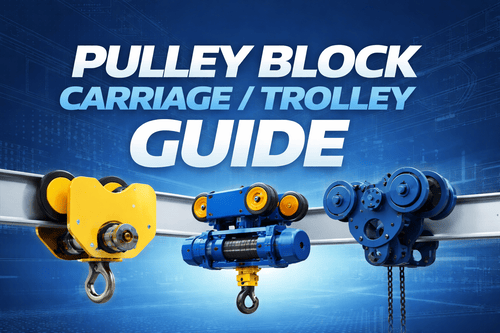
Short answer: In most manual hoisting applications, a pulley block carriage and a hoist trolley describe the same basic travel assembly: a wheeled frame that supports a chain pulley block and moves it along an overhead beam. The important choice is usually the trolley type—plain/push-pull, geared, electric, or low-headroom—based on load, travel control, beam size, headroom, frequency of use, and the hoist manufacturer’s rated limits.
Pulley Block Carriage vs Trolley: The Key Difference
For Mumbai sourcing, see our chain pulley block supplier in Mumbai page and explore the A Series chain pulley block.
Think of the carriage/trolley as the travel system and the chain pulley block as the lifting system. The trolley supports the hoist and moves along the beam; the hoist raises and lowers the load. Some products are supplied as an integrated trolley-mounted hoist, while others combine a separately selected trolley and chain pulley block.
| What you are comparing | What it does | What to check |
|---|---|---|
| Chain pulley block | Raises and lowers the load | Rated WLL/SWL, lift height, chain, hooks and operating conditions |
| Plain trolley / carriage | Allows manual travel along the beam | Capacity, beam flange range, travel effort and clearance |
| Geared trolley | Provides controlled manual travel through a hand chain and gearing | Capacity, beam dimensions, hand-chain clearance and travel path |
| Electric trolley | Provides powered travel | Capacity, power supply, controls, duty, travel speed and maintenance |
Hoist Trolley Types: Quick Reference
| Feature | Manual Trolley | Geared Trolley | Electric Trolley |
|---|---|---|---|
| Best For | Occasional manual positioning | Controlled manual travel | Frequent or repetitive travel |
| Operation | Hand-pushed | Hand chain operated | Motorized control |
| Cost | Budget-friendly | Moderate | Higher investment |
| Speed | Slow | Medium | Fast & efficient |
| Maintenance | Minimal | Regular checks needed | Requires professional care |
When you walk into any factory, warehouse, or construction site, you’ll often see heavy materials moving smoothly overhead. The magic behind this movement? A simple yet brilliant device called a pulley trolley or pulley block carriage.
Let me explain what this equipment does in the simplest way possible.
What Exactly Is a Pulley Block Carriage?
Think of it like a shopping cart that runs on a ceiling track. Just as your shopping cart helps you move groceries around the store, a pulley block carriage helps workers move heavy materials around a workspace—but overhead instead of on the floor.
The trolley has wheels that roll along an I-beam (that’s the metal track on the ceiling). Attached to this trolley is a hoist—the lifting mechanism that goes up and down. Together, they let you lift something heavy and move it to exactly where you need it.
Why Do We Need These Trolleys?
Imagine trying to lift a 500-kilogram steel beam. Even if you manage to lift it straight up, you’d still need to move it across the room. That’s where the trolley becomes your best friend. It does two jobs at once:
- Lifts heavy things up (vertical movement)
- Moves them across (horizontal movement)
This saves time, reduces the number of workers needed, and most importantly—keeps everyone safe.
Different Types of Hoist Trolleys
Just like cars come in different models for different needs, hoist trolley types vary based on what work you’re doing.
1. Plain Trolley (Manual Push)
This is the simplest type. The operator pushes the trolley along the beam. It can suit occasional positioning where the load, beam and trolley are within the manufacturer’s rated limits. Do not select a plain trolley by assuming that all loads below a particular tonnage are suitable; capacity and beam compatibility vary by model.
2. Geared Trolley
This type uses a hand chain and gearing to move the trolley along the beam with more controlled travel than a plain push trolley. It is useful where operators need repeatable manual positioning. Confirm the trolley’s rated capacity, compatible beam flange width, hand-chain clearance and travel path before installation.
3. Electric Trolley
This trolley uses a motor to provide powered travel. It can be useful for frequent handling or applications where manual travel would be inefficient. Electric travel should be selected from the manufacturer’s rated capacity, travel speed, duty requirements, power supply, controls and environmental conditions—not simply because the load is ‘heavy’.
4. Low Headroom Trolley
Some buildings have limited ceiling height. Low headroom trolleys are specially designed to fit in tight vertical spaces while still doing the same job. They’re compact and save valuable overhead room.
How to Choose the Right Trolley
Picking the right trolley isn’t complicated. Ask yourself these questions:
Load capacity: The trolley and hoist must each be rated for the intended load. Include the load and any below-the-hook equipment carried by the lifting system, and follow the manufacturer’s stated limits.
Travel frequency and control: Occasional positioning may suit a plain or geared trolley. Frequent or repetitive travel may justify powered travel, provided the duty and electrical requirements match the application.
Beam compatibility: Check the beam profile, flange width, beam condition and trolley adjustment range. A trolley that fits the load rating but does not match the beam is not a suitable installation.
Headroom and environment: Compare the available vertical clearance with the trolley, hoist body and hook position. Also check temperature, dust, moisture, corrosion and any obstructions along the travel path before selecting the equipment.
Safety Tips to Remember
Before operation, verify the rated capacity, inspect the trolley wheels, frame, hooks and chain, and confirm the trolley is correctly fitted to the beam. Check the beam and travel path for damage, obstructions or conditions that could cause binding or side loading. Never exceed the manufacturer’s rated capacity, never use a trolley as a substitute for a properly designed lifting arrangement, and keep people clear of suspended loads.
A Simple Buying Checklist
- Confirm the maximum total suspended load.
- Choose a hoist and trolley with compatible rated capacities.
- Measure the supporting beam and verify the trolley’s flange range.
- Check required lift height and available headroom.
- Decide whether push, geared or powered travel is appropriate.
- Confirm the environment, travel path, duty and manufacturer restrictions.
- Have the supporting structure and installation checked by a competent person where required.
Final Thoughts
Whether you call it a pulley block carriage, pulley trolley, or hoist trolley, this equipment is essential for modern material handling. At V-talhoist, we understand that choosing the right trolley can make your work easier, faster, and safer.
The right trolley doesn’t just move materials—it moves your business forward.