

Short answer: A 1-ton hoist can be enough for many workshop, maintenance, manufacturing, fabrication, and warehouse applications. However, the 1-ton capacity alone does not determine whether it is the right choice. You also need to consider the actual suspended load, lifting frequency, lift height, headroom, support structure, lifting speed, and working environment.
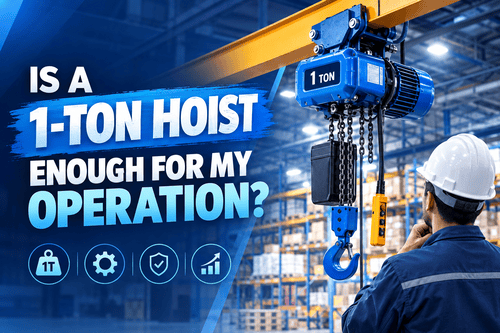
For example, a workshop that occasionally lifts a 500–700 kg machine may work comfortably with a 1-ton hoist. But if the same hoist is used repeatedly throughout a production shift, the duty rating, motor, brake, lifting speed, and operating cycle become equally important.
So, before buying a 1-ton hoist, work through these checks.
1. Start With the Actual Weight You Need to Lift
The first mistake buyers make is looking only at the weight of the main item.
The hoist is lifting the complete suspended load, not just the machine, component, or material. Your calculation should consider the load together with the relevant lifting accessories attached below the hook.
| What to consider | Example |
|---|---|
| Main load | 750 kg machine |
| Slings and shackles | Additional suspended weight |
| Lifting beam or fixture | Include if attached during the lift |
| Total suspended load | Use this figure when checking hoist capacity |
If your heaviest complete suspended load is already close to 1,000 kg, a 1-ton hoist is not automatically the right choice. You should not plan routine lifting right at the maximum rated capacity without checking the manufacturer’s specifications, duty classification, and application requirements.
2. Understand What “1 Ton” Actually Means
A 1-ton hoist rating refers to its rated lifting capacity or safe working load under the specified conditions. It does not mean that every 1-ton model has the same performance.
Two hoists can both be rated at 1 ton but have very different:
- Lifting speeds
- Duty classifications
- Motor ratings
- Brake designs
- Lift heights
- Headroom requirements
- Trolley configurations
- Operating cycles
- Environmental protection
This is why choosing equipment only by the number printed on the capacity label can lead to the wrong specification.
3. Check How Often You Will Use the Hoist
This is one of the most important questions for an industrial application.
If the hoist is used occasionally for maintenance work, capacity may be your primary concern. If operators are lifting loads repeatedly throughout the day, duty classification becomes much more important.
| Application pattern | What to examine |
|---|---|
| Occasional maintenance | Capacity, lift height, installation and safety features |
| Regular workshop lifting | Capacity, duty class, lifting speed and cycle frequency |
| Repeated production lifting | Duty class, motor, brake, starts per hour and operating time |
| Heavy continuous operation | Application-specific engineering and higher-duty equipment |
A 1-ton hoist that is suitable for occasional lifting may not be the best choice for a production line running repeated lifting cycles every few minutes.
Before purchasing, tell the supplier approximately how many lifting cycles you expect per hour and how many hours the hoist will operate per shift.
4. Do Not Ignore Lift Height
Capacity tells you how much the hoist can lift. It does not tell you how high it can lift.
Suppose your application requires lifting a 700 kg component by 8 metres. A standard 1-ton hoist may have the required capacity, but you still need to specify the correct chain length, control arrangement, and installation configuration.
Higher lift requirements can also affect the overall installation, chain collection, and available working space.
5. Measure Headroom Before Ordering
Headroom is often overlooked until the hoist reaches the installation site.
The distance between the supporting beam and the hook matters when you need to lift a load as high as possible. A bulky hoist can reduce the usable lifting height even if its capacity is correct.
This becomes particularly important in factories, workshops, and warehouses where the available building height is limited.
Before ordering, measure:
- Beam height
- Available clearance below the beam
- Maximum required hook height
- Load height
- Required lifting travel
If space is restricted, ask the supplier about a low-headroom configuration rather than assuming every 1-ton hoist will fit.
6. Check How the Hoist Will Be Supported
A correctly rated hoist does not make an unsuitable supporting structure safe.
The beam, trolley, jib crane, gantry, or other supporting arrangement must be suitable for the intended load and configuration. The supporting structure also needs to account for the equipment itself and the way the load is applied.
This is particularly important when installing a new hoist on an existing beam. Do not assume that because an old hoist was installed there, a new 1-ton unit can automatically be fitted without checking the structure.
7. Decide Whether You Need Fixed, Push-Trolley or Motorized Travel
A 1-ton capacity does not determine how the load should move horizontally.
If the load only needs to move vertically from one fixed location, a fixed suspension arrangement may be sufficient.
If the load needs to move along an I-beam, you may need a push trolley or motorized trolley depending on the application.
For repeated movement over a longer runway, powered travel can make the operation much more practical. The right configuration depends on the layout, load type, travel distance, and frequency of movement.
8. Manual Hoist or Electric Hoist?
For occasional lifting, a manual chain hoist can be a practical solution, particularly where electrical power is unavailable or the number of lifts is low.
For repetitive industrial lifting, an electric solution can reduce operator effort and make lifting more consistent.
For example, an Electric Chain Hoist can be considered when the operation requires powered lifting, controlled lifting speed, and repeated cycles.
The choice should still be based on the complete application rather than simply selecting the powered option because it is faster.
9. Consider the Working Environment
A hoist working inside a clean workshop does not face the same conditions as one installed in a dusty, humid, outdoor, or corrosive environment.
Before selecting the equipment, check whether the application involves:
- Dust
- Moisture or water exposure
- High temperatures
- Corrosive materials
- Outdoor installation
- Long operating periods
- Restricted ventilation
The required protection level, motor configuration, and accessories may change depending on the environment.
10. A Simple Example: Is 1 Ton Enough?
Consider a fabrication workshop that needs to lift a machine component weighing 650 kg.
| Requirement | Application |
|---|---|
| Maximum component weight | 650 kg |
| Lifting accessories | Included in total suspended load calculation |
| Required lifting height | 5 metres |
| Usage | Several lifts per day |
| Movement | Vertical lifting with occasional beam travel |
| Initial capacity option | 1 ton |
A 1-ton hoist may be a reasonable starting point because the normal load is substantially below its rated capacity.
However, the buyer should still confirm the complete suspended load, duty classification, lifting height, trolley arrangement, supporting structure, and manufacturer’s limitations before placing the order.
Now change the example to a 950 kg load that is lifted dozens of times every shift. The answer is no longer simply “1 ton is enough.” The application needs a closer engineering review because the load is much closer to the rated limit and the operating duty is considerably higher.
11. When Should You Consider a Higher Capacity?
Consider moving to the next capacity class when:
- Your actual maximum suspended load is close to the hoist’s rated capacity.
- The load varies significantly and the heavier loads are frequent.
- The lifting accessories add substantial weight.
- The operating duty is higher than the selected hoist is designed for.
- The manufacturer’s application data indicates a higher-capacity model.
- The installation or lifting configuration creates additional requirements that cannot be met by the selected model.
However, choosing a much larger hoist is not automatically better.
A larger unit can increase equipment weight, installation requirements, cost, and space requirements. The objective is to select the capacity and duty specification that properly matches the actual operation.
12. Use This Checklist Before Buying a 1-Ton Hoist
| Question | Checked? |
|---|---|
| What is the maximum complete suspended load? | ☐ |
| What lifting height is required? | ☐ |
| How many lifts are performed per hour? | ☐ |
| How many hours per shift will the hoist operate? | ☐ |
| Is the required duty class confirmed? | ☐ |
| Is sufficient headroom available? | ☐ |
| Is the beam, trolley, or support structure suitable? | ☐ |
| Is fixed, push, or motorized travel required? | ☐ |
| Is the working environment suitable for the selected model? | ☐ |
| Are the manufacturer’s specifications and rated capacity confirmed? | ☐ |
Final Answer: Is a 1-Ton Hoist Enough?
For many workshops, maintenance departments, fabrication units, and general industrial applications, a 1-ton hoist can be an appropriate choice. But you should not make the decision from capacity alone.
The right question is not simply:
“Does my load weigh less than 1 ton?”
It is:
“Does a 1-ton hoist, with the correct duty rating and configuration, safely and efficiently match my heaviest suspended load, lifting frequency, height, headroom, support structure, and working environment?”
If the answer is yes, a 1-ton model may be exactly what your operation needs. If the load is close to the rated capacity or the hoist will work continuously, review the duty and configuration before making the purchase.
For industrial lifting requirements, Uhmi V-tal Hoist can help you evaluate the required capacity, configuration, and application before selecting the equipment.
Is a 1-ton hoist suitable for daily industrial use?
It can be, but daily use requires checking the hoist's duty classification, operating time, lifting cycles, and manufacturer's specifications. Capacity alone does not determine whether a hoist is suitable for continuous or repetitive work.
What is more important, hoist capacity or duty rating?
Both matter. The capacity must cover the intended suspended load, while the duty rating must match how frequently and intensively the hoist will operate.
Should I buy a 2-ton hoist instead of a 1-ton hoist?
Not automatically. A larger capacity may be unnecessary if your application is correctly covered by a 1-ton unit. Select the capacity based on the actual load and then match the duty and configuration to the operation.
Does lift height affect the hoist I need?
Yes. Lift height affects chain length, installation arrangement, available headroom, and sometimes the overall equipment configuration. Confirm the required hook travel before ordering.