
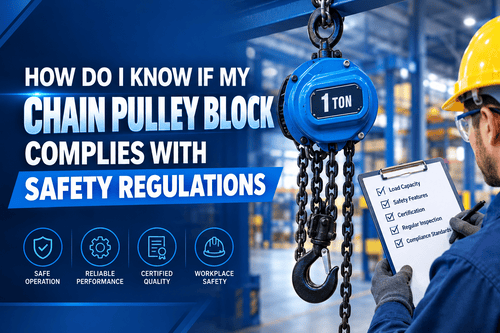
Direct answer: You can check compliance by verifying the equipment’s identification and safe working load, applicable Indian Standard, manufacturer and test documents, current inspection certificate, and physical condition. In Maharashtra, a lifting machine or lifting tackle used in a factory must be tested and thoroughly examined by a competent person, with the certificate kept available for inspection. The current Maharashtra Factories Rules also require periodic examination.
1. Start With the Nameplate
Before checking certificates, look at the identification plate fixed to the equipment.
| What to check | Why it matters |
|---|---|
| Safe Working Load (SWL) | Tells you the maximum rated load |
| Manufacturer/trade mark | Helps establish product identity |
| Serial or code number | Allows traceability to records |
| Load chain grade | Identifies the chain specification |
| Lift range | Confirms the intended lifting range |
| Standard/certification details | Helps verify applicable compliance |
IS 3832:2005, the Indian Standard for hand-operated chain pulley blocks, specifies marking and traceability information including SWL, load-chain grade, lift range, manufacturer identification and serial/code information.
If the nameplate is missing, unreadable or does not match the supplied documents, stop and investigate before using the equipment.
2. Check the Applicable Indian Standard
For hand-operated chain pulley blocks, IS 3832:2005 is the key Indian Standard to look for.
The standard covers important areas including construction, components, load chain, braking arrangements, suspension fittings, testing and safe-use recommendations. BIS documentation for the standard describes design requirements and testing, including proof testing at 1.5 times the working load limit and other performance checks.
Do not simply accept a supplier’s statement that a block is “ISI quality.” Ask for the actual supporting documentation.
For procurement, also verify the manufacturer’s current BIS licence and Standard Mark details where applicable rather than relying on an old certificate or a catalogue statement.
3. Don’t Confuse a Product Certificate With a Current Safety Certificate
This is one of the most important points for buyers.
A manufacturer’s certification tells you about the product’s conformity when it was manufactured or tested. It does not automatically prove that the particular block is safe to use today.
For example, a 5-ton block may have been correctly manufactured, but years of use could have caused:
- Elongation or damage to the load chain
- Hook opening or deformation
- Worn gears
- Brake problems
- Cracks or corrosion
- Damaged safety latches
- Unauthorised repairs
- Missing components
Maharashtra’s rules require lifting machines, chains and lifting tackles used in factories to be tested and thoroughly examined by a competent person, with the safe working load stated on the certificate. The current rules provide for examination at least once every twelve months.
So think of compliance as two checks: product conformity + current equipment condition.
4. Ask for the Test and Examination Record
If your equipment is used in a Mumbai or Maharashtra factory, documentation matters.
The examination record should identify the equipment and show details such as its identification number, description, examination date, certificate details, defects found and corrective action where applicable.
Maharashtra’s rules provide a prescribed register for lifting machines, chains, ropes and lifting tackles, including examination and certificate details.
A good compliance file should therefore contain:
- Purchase invoice or equipment record
- Manufacturer’s certificate
- Test/proof-load certificate
- Serial number and equipment identification
- Latest competent-person examination report
- Maintenance and repair history
- Records of any replacement parts or major repairs
This makes an audit much easier because you can connect the physical equipment to its documentation.
5. Inspect the Parts That Actually Carry the Load
Paperwork is important, but never inspect a lifting block only on paper.
Before use, check the major load-bearing components.
Load chain
Look for stretched, twisted, cracked, bent, heavily worn or corroded links. Do not continue using a chain simply because it “still lifts.”
Hooks
Check both hooks for cracks, twisting, excessive opening or deformation. A working safety latch should also be present and function correctly.
Brake
The load should remain controlled during lifting and lowering. Any slipping, uncontrolled movement or unusual behaviour needs investigation before further use.
Gears and mechanism
Grinding sounds, jerky movement or excessive resistance can indicate internal wear or damage.
Body and suspension point
Inspect the frame, suspension hook and other structural parts for cracks, deformation or corrosion.
A basic visual inspection cannot replace a competent examination, but it can prevent an obviously damaged block from being put into service.
6. Check Whether the Actual Load Matches the Rated Capacity
Never select equipment simply because its capacity is close to the load.
For example, if the load is 4.8 tonnes, using a 5-ton block leaves very little practical margin for uncertainty in the load weight, lifting arrangement or operating conditions.
Also consider:
- Actual load weight
- Lift height
- Frequency of lifting
- Headroom
- Suspension arrangement
- Load shape and centre of gravity
- Environmental conditions
- Whether the block is being used with a trolley
The rated capacity of the block must never be exceeded.
7. Pay Attention to Repairs and Modifications
A repaired lifting block needs special attention.
Maharashtra’s rules state that lifting machines, chains and lifting tackles that have been lengthened, altered or repaired by welding or otherwise should not be returned to service until they have been adequately tested and examined by a competent person and certified as being in order.
This is particularly important with older equipment.
Do not assume that replacing a hook, chain or brake component automatically makes the block compliant. The replacement must be suitable, and the equipment may need further examination or testing depending on the repair.
A Simple 5-Minute Compliance Check
| Check | Yes/No |
|---|---|
| Is the SWL clearly marked and suitable for the load? | ☐ |
| Does the equipment have identifiable manufacturer/serial details? | ☐ |
| Are the relevant certificates and test records available? | ☐ |
| Is the latest competent-person examination valid? | ☐ |
| Are the chain, hooks, brake and body free from obvious defects? | ☐ |
If any answer is “No,” don’t treat the equipment as automatically compliant.
Why This Matters for Buyers in Mumbai
Mumbai’s factories, warehouses, engineering workshops, construction projects and maintenance facilities use lifting equipment in very different conditions. A block used occasionally indoors will not experience the same conditions as one used every day around dust, moisture, chemicals or outdoor work.
When buying from a Chain Pulley Block Supplier in Mumbai, ask more than just the price and capacity. Ask for the standard, certificate, serial-number traceability, inspection support and after-sales service.
A reliable supplier should be able to explain what documentation accompanies the equipment and what inspections are recommended for the application.
Uhmi V-tal Hoist can help businesses evaluate lifting requirements and select suitable material-handling equipment based on capacity, application and operating conditions.
What Should You Do If the Certificate Is Missing?
Do not assume the block is unsafe solely because a document cannot be found—but do not put it into service without verification either.
First, record the manufacturer’s name, model, serial number, capacity and other markings. Then contact the manufacturer or supplier to establish whether the equipment can be traced.
If the history cannot be established, arrange examination and testing through a competent person as appropriate to the workplace and applicable regulations.
For older equipment, this approach is often safer than trying to recreate a certificate from incomplete information.
Final Takeaway
Checking a chain pulley block for compliance is not just about finding an ISI mark.
A safer approach is to verify five things together: the applicable standard, equipment identification, test documentation, current competent-person examination and actual physical condition.
For factories in Maharashtra, maintaining the required examination records is particularly important.
If any one of these areas is unclear, the equipment should be investigated before lifting a load. Good documentation and regular inspection are not paperwork for its own sake—they help prove that the lifting equipment being used on the shop floor is the same equipment that was tested and approved.
Is an ISI mark alone enough to prove that my chain block is safe?
No. Product certification and workplace safety are different checks. The equipment must also be properly maintained and periodically examined as required by the applicable workplace regulations.
How often should a chain pulley block be examined in a Maharashtra factory?
Maharashtra Factories Rules provide for testing and thorough examination by a competent person before first use and thereafter at least once every twelve months, with the certificate kept available for inspection.
What should I check before using a chain pulley block?
Check the SWL marking, chain, hooks, safety latches, brake, gears, frame, suspension point and visible signs of corrosion or damage. Also confirm that the required inspection and test documentation is current.
Can I use a chain pulley block after repairing or welding it?
Not automatically. Equipment that has been altered or repaired by welding or other methods needs appropriate testing and examination by a competent person before it is returned to service.
What documents should I ask a supplier for?
Ask for the manufacturer's documentation, equipment identification details, relevant conformity/test certificates, safe working load information and any documentation required for the applicable workplace inspection regime.
Where can I buy compliant lifting equipment in Mumbai?
Choose a supplier that can provide traceable equipment, relevant certification, technical guidance and after-sales inspection or service support rather than choosing solely on price.