

If you run a small workshop, you already know the tension: you need real lifting capability for engine blocks, machine parts, or heavy stock, but you don’t have the ceiling height, floor space, or budget of an industrial shop floor. A chain pulley block is usually the answer — it’s compact, doesn’t need electricity, and can be mounted almost anywhere you’ve got a solid overhead beam or a portable gantry. The trick is picking the right one, because “chain pulley block” covers a wide range of capacities, chain falls, and build quality, and the wrong choice either underdelivers on lifting power or takes up more space and budget than a small workshop actually needs.
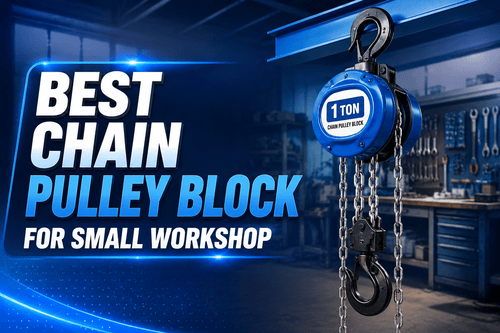
This guide walks through how to think about that choice — what actually matters for a small workshop setting, and what tends to be overkill.
Why a Chain Pulley Block Fits Small Workshops So Well
Unlike electric hoists, a manual chain pulley block needs no power source, which matters a lot in workshops where wiring an overhead point isn’t practical or where the lift is occasional rather than constant. It’s also lighter, cheaper, and easier to relocate — many small workshop owners mount one on a simple trolley or portable A-frame gantry and move it between work bays as needed.
The tradeoff is speed: manual chain hoists lift slower than electric ones. For a small workshop doing occasional lifts — engine removal, machine repositioning, loading heavy stock onto a bench — that tradeoff is almost always worth it for the savings in cost, complexity, and space.
Capacity: The First Decision, Not the Last
The single biggest mistake in small workshop hoist buying is picking capacity based on the heaviest thing you can imagine lifting someday, rather than what you’ll actually lift regularly.
- 0.5–1 ton covers most small engine components, gearboxes, and general workshop parts handling.
- 1–2 tons is the sweet spot for most small automotive or fabrication workshops — enough for engine blocks, transmissions, and heavier machine parts without the bulk of an industrial-capacity unit.
- 3 tons and above starts to be genuinely heavy-duty territory, and unless your workshop regularly handles industrial machinery, it’s usually more hoist than you need — bigger housing, heavier chain, more ceiling clearance required.
A good rule of thumb: pick the capacity for your heaviest regular lift, then check it comfortably covers your occasional heavier one with margin to spare. Don’t buy for the one-off job you might do twice a year.
Headroom: The Constraint Everyone Forgets
Small workshops often have lower ceilings than the space calculations assume, and headroom — the distance between the hook in its fully raised position and the top mounting point — is one of the most overlooked specs. A hoist with poor headroom efficiency eats into your usable lift height before you’ve moved anything.
Before buying, measure your actual mounting point height and the tallest item you need to lift clear of the ground or a bench. Compact-bodied chain pulley blocks are worth prioritizing in low-ceiling workshops specifically because they preserve more usable lift height.
Chain Fall: Single vs. Double
Chain pulley blocks come in single-fall and double-fall (and higher) configurations. A single-fall chain runs directly to the hook; a double-fall configuration routes the chain through an additional sheave, which increases lifting capacity for the same hand-chain effort but usually adds body height and reduces headroom.
For most small workshop needs under 2 tons, a single-fall hoist is usually sufficient and keeps the unit compact. Double-fall setups become more relevant at higher capacities where the mechanical advantage is needed to keep hand-chain pull effort manageable.
Build Quality Signals Worth Checking
Not all chain pulley blocks in a given capacity class are built the same. A few things worth checking before buying:
- Load chain grade — hardened alloy chain rated for the hoist’s stated capacity, not a generic chain retrofitted to a housing.
- Braking mechanism — a reliable, self-engaging load brake that holds position without drift is non-negotiable, especially in a workshop where a load might sit suspended mid-task.
- Housing material — cast construction tends to hold up better under repeated use than lightweight stamped housings, especially if the hoist gets moved between mounting points often.
- Hook swivel and safety latch — a smooth-rotating hook with a functioning safety latch reduces load shifting and accidental disengagement.
A hoist that’s slightly more expensive but built with proper chain grade and a dependable brake is almost always the better long-term investment over a cheaper unit that needs closer monitoring or earlier replacement.
Portability Considerations
Many small workshops don’t have a single fixed lifting point — they need to move the hoist between bays or use it with a portable gantry. If that’s your setup, look for:
- A manageable overall weight for the hoist itself, since it’ll be lifted and repositioned by hand
- A trolley-compatible top hook or beam clamp option, if you plan to run it along an I-beam
- A compact housing that doesn’t require excessive clearance to swing or reposition
A Simple Way to Decide
If you’re narrowing down options for a small workshop, this sequence works well:
- Identify your heaviest regular lift and size capacity to comfortably cover it (usually 1–2 tons for most small workshops).
- Measure your actual mounting height and prioritize a compact-bodied unit if headroom is tight.
- Default to single-fall unless your capacity needs push you into double-fall territory.
- Check chain grade, brake reliability, and housing build before comparing price.
- Confirm portability needs — fixed point vs. trolley or gantry use — before finalizing.
Final Thoughts
The best chain pulley block for a small workshop isn’t the biggest or the cheapest one available — it’s the one sized correctly for your actual regular lifts, that fits your ceiling height without eating into usable lift range, and that’s built well enough that the brake and chain don’t become a maintenance headache six months in. Getting those three things right matters far more than chasing extra capacity you’ll rarely use.
For small workshop setups, V-TAL Hoist’s chain pulley block range covers a range of capacities and configurations worth comparing against your specific space and lifting needs.
Does a chain pulley block need electricity?
No. A manual chain pulley block operates entirely by hand chain, which makes it well suited to workshops where wiring an overhead power point isn't practical or where lifts are occasional rather than constant.
What is headroom and why does it matter for small workshops?
Headroom is the distance between the hook in its fully raised position and the top mounting point. In low-ceiling workshops, a hoist with poor headroom efficiency reduces the usable lift height available before you've even started lifting.
Should I choose a single-fall or double-fall chain pulley block?
For most small workshop needs under 2 tons, a single-fall hoist is usually sufficient and keeps the unit compact. Double-fall configurations are more relevant at higher capacities where extra mechanical advantage is needed.
Can a chain pulley block be moved between different areas of a workshop?
Yes, many small workshops use a chain pulley block with a trolley or portable gantry so it can be repositioned between work bays rather than mounted permanently in one spot.
What should I check for build quality when buying a chain pulley block?
Look for hardened alloy load chain rated to the hoist's stated capacity, a reliable self-engaging brake, solid housing construction, and a smoothly rotating hook with a functioning safety latch.