
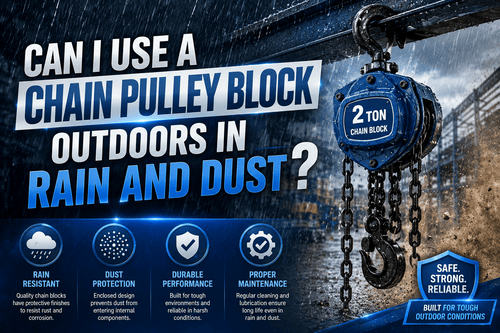
Yes, you can use a chain pulley block outdoors in rain and dust, but not every unit is built for it, and not without some care. Standard chain blocks meant for indoor workshop use will rust, seize up, or wear out fast if left exposed to monsoon weather or constant dust without protection. If your work happens on open construction sites, ports, or outdoor yards in India, you need a unit with proper corrosion-resistant finishing, sealed gear housing, and a chain grade that won’t pit or rust quickly.
So the real answer isn’t just “yes” or “no” — it depends on the build of the hoist and how well you maintain it.
What Actually Damages a Chain Block Outdoors
Most people assume it’s just rust, but there are a few separate problems happening at once on an open site:
- Rain and humidity — water gets into the gear casing and load hook bearing, washing out grease and causing internal rust that you can’t see from outside.
- Dust and grit — fine dust from construction sites gets into the chain links and gear teeth, acting like sandpaper every time the chain moves.
- Temperature swings — hot days followed by sudden rain cause condensation inside the casing, which speeds up corrosion.
- Coastal air — if you’re near the coast, salt in the air accelerates rusting on any unprotected metal parts, even without direct rain contact.
None of this means outdoor use is unsafe — it just means the equipment needs to be chosen and maintained with these conditions in mind.
Which Uhmi V-talhoist Series Handles Outdoor Use Better?
Between the two common lines, the A Plus Series is generally the stronger pick for tough outdoor sites. It has a heavier gear casing with better sealing, which keeps dust and moisture out of the internal gear train. For construction sites, steel yards, or ports where the hoist sits outdoors for weeks at a stretch, this extra protection matters a lot over time.
The M Series Chain Pulley Block can also handle occasional outdoor exposure — a few hours here and there, or short-term site work — but it’s not built with the same level of sealing, so it’s better suited to being moved indoors or under cover when not in use.
Either way, neither series is meant to sit permanently uncovered in open rain. Even weatherproof-rated hoists last longer with basic shelter, like a tarp or shed roof over the lifting point.
Quick Comparison Table
| Factor | A Plus Series | M Series |
|---|---|---|
| Outdoor suitability | Good for regular outdoor/site use | Better for occasional outdoor use |
| Gear casing sealing | Heavier, better sealed | Lighter, less sealed |
| Recommended for coastal sites | Yes, with regular maintenance | Only with frequent inspection |
| Dust resistance | Higher | Moderate |
| Maintenance need in rain season | Monthly check-up | Check before and after every outdoor use |
| Best practice | Cover when idle, grease chain often | Store indoors between uses |
How to Protect Any Chain Block Used Outdoors
- Cover it when it’s not lifting. A simple tarp or plastic sheet over the hoist body during rain breaks makes a real difference.
- Grease the chain regularly. Dust sticks to a dry chain much faster than a lubricated one, so re-grease more often on outdoor jobs than you would indoors.
- Wipe down after rain exposure. Standing water on the casing, even briefly, invites rust — a quick wipe-down at the end of the day helps a lot.
- Check the hook and load chain weekly. Outdoor grit collects in the chain links faster than people expect; a weekly visual check catches problems before they become safety issues.
- Store it indoors overnight when possible. Even on long outdoor projects, bringing the hoist inside overnight cuts down on prolonged moisture exposure.
- Ask for a corrosion-resistant finish upfront. If you know the unit is going straight to an outdoor site, mention this when buying — some finishing options handle humidity noticeably better than the standard coating.
Bottom Line
Outdoor use isn’t a problem by itself — the issue is using an indoor-spec hoist outdoors without any protection or maintenance. Choose a build meant for site conditions, keep it covered and greased, and it’ll hold up through a full monsoon season without trouble. Uhmi V-talhoist units are built to handle Indian site conditions, but even the toughest hoist benefits from basic care when it’s living outdoors for weeks at a time.
Can I leave a chain block hanging outdoors overnight?
It's better not to, especially during monsoon months. If bringing it indoors isn't practical, at minimum cover it with a tarp and wipe it down the next morning before use.
Does dust affect the chain or the gears more?
Both, but the chain links usually show wear first since they're constantly moving against each other. Dust acts as an abrasive, so a dry, dusty chain wears faster than a clean, greased one.
s a stainless or galvanized chain necessary for coastal sites?
It's strongly recommended. Salt air speeds up corrosion on regular finishes, so a corrosion-resistant chain and casing finish pays off quickly in coastal or humid regions.
How often should an outdoor chain block be serviced compared to an indoor one?
Roughly twice as often. If an indoor unit gets serviced every 6 months, an outdoor unit under regular rain and dust exposure should be checked closer to every 2-3 months.