
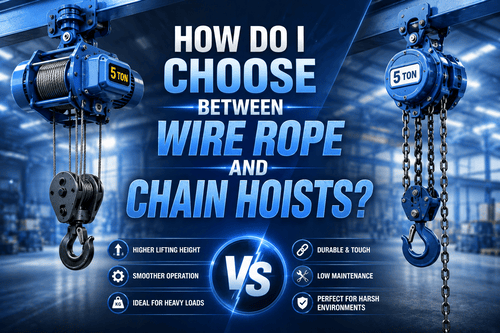
If you’ve ever stood in front of two hoist options and wondered which one actually fits your job, you’re not alone. This is one of the most common questions we hear from plant managers, contractors, and warehouse owners across India. And honestly, there’s no single “better” option — it depends entirely on what you’re lifting, how often, and where.
Let’s break it down in plain terms.
The Short Answer
If you need to lift moderate loads (up to around 20-25 tons) in a compact space, with lower upfront cost and easy maintenance, go with a chain hoist. If you’re dealing with heavier loads, longer lifting heights, or continuous industrial-duty operation like in steel plants or ports, a wire rope hoist is usually the smarter pick.
That’s the quick version. Now here’s why.
Chain Hoists: Compact, Reliable, Budget-Friendly
Chain hoists work well when your space is tight and your lifting needs are moderate. They’re built using a chain and sprocket system, which makes them simpler mechanically — fewer parts to worry about, and generally lower maintenance costs over time.
At Uhmi V-talhoist, we see a lot of demand for electric chain hoists from small and mid-sized manufacturing units, workshops, and garages. Why? Because they’re compact, don’t need a lot of headroom, and are easier on the pocket both at purchase and during upkeep.
The tradeoff is capacity and speed. Chain hoists typically top out at lower tonnage compared to wire rope systems, and they’re not usually the first choice for high-speed, high-frequency lifting cycles. If your operation runs multiple shifts with heavy repetitive lifting, the chain can wear faster than you’d like.
Wire Rope Hoists: Built for Heavy, Continuous Work
A wire rope hoist is the go-to when you’re lifting heavier loads over longer distances — think steel mills, cement plants, shipyards, or large warehouses with high-bay storage. These hoists use a steel wire rope wound around a drum, which allows for higher lifting capacities, often well beyond what a chain system can handle.
They also tend to run smoother at higher speeds, which matters a lot if your operation depends on quick turnaround times. Maintenance is a bit more involved compared to chain hoists — the rope needs periodic inspection for fraying or wear — but for heavy-duty, round-the-clock industrial use, it’s usually worth it.
So, Which One Fits Your Situation?
Here’s a quick way to think about it:
- Load capacity: Light to medium loads → chain hoist. Heavy loads → wire rope hoist.
- Headroom available: Limited space → chain hoist is more compact. Larger facilities → wire rope hoists work better with more vertical room.
- Duty cycle: Occasional lifting → chain hoist is cost-effective. Continuous, multi-shift operation → wire rope hoist handles the wear better.
- Budget: Chain hoists are generally cheaper upfront and easier to maintain. Wire rope hoists cost more initially but pay off in heavy industrial settings.
At Uhmi V-talhoist, we usually recommend customers walk through their actual daily lifting requirements first — tonnage, frequency, lift height — before deciding. A hoist that’s oversized for your needs wastes money; one that’s undersized wears out fast and becomes a safety risk.
A Quick Note on Safety and Compliance
Whichever hoist you choose, make sure it complies with relevant Indian safety standards and comes with proper load testing certification. This isn’t just a formality — it protects your workers and your equipment investment long-term.
If you’re still unsure, it’s worth getting an on-site or virtual consultation before finalizing your purchase. Every facility has its quirks, and a hoist that worked great for a neighboring plant might not be the right call for yours.
Which is cheaper — chain hoist or wire rope hoist?
Chain hoists are usually less expensive upfront and have lower maintenance costs, making them a good fit for small to mid-sized operations.
Can I use a chain hoist for outdoor or continuous industrial work?
It's possible, but not ideal for heavy, round-the-clock use. Wire rope hoists tend to handle continuous duty cycles better.
How do I know the right hoist capacity for my facility?
It depends on your maximum load weight, lift height, and frequency of use. Consulting with an electric chain hoist manufacturer like Uhmi V-talhoist can help match the right model to your needs.
Do wire rope hoists need more maintenance?
Yes, slightly. The wire rope needs regular inspection for wear or fraying, whereas chain hoists are comparatively low-maintenance.