

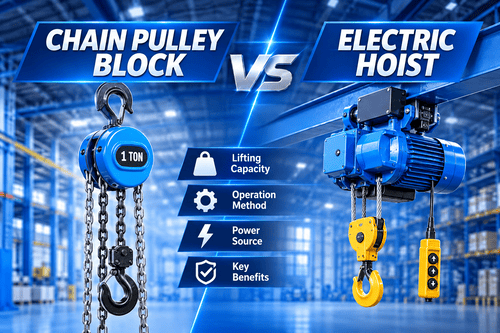
Choose a manual chain pulley block for occasional lifting, maintenance work, locations without reliable electricity and jobs where lifting speed is not critical. Choose an electric hoist for frequent lifting, production operations, heavier daily workloads and situations where reducing operator effort and saving time are important. The right choice depends on more than capacity: lifting frequency, duty cycle, lift height, installation, power supply and total operating cost must also be considered.
In factories, warehouses, workshops and construction projects, selecting the wrong lifting equipment can increase labour costs, slow down operations and create unnecessary maintenance problems. Although both options lift and lower loads, they are designed for different working conditions.
Here is how to decide which one makes more sense for your operation.
1. What is the difference between a chain pulley block and an electric hoist?
A Chain Pulley Block uses a manual hand chain and a gear mechanism to lift a load. An Electric Hoist uses an electric motor to operate the lifting mechanism through a push-button or pendant control.
The biggest difference is how the lifting work is performed. One depends on the operator’s physical effort; the other uses motor power.
| Comparison factor | Manual chain pulley block | Electric hoist |
|---|---|---|
| Operating method | Hand chain | Electric motor |
| Power requirement | No electricity | Requires suitable power supply |
| Lifting speed | Depends on operator | Generally faster and consistent |
| Operator effort | Physical effort required | Lower physical effort |
| Best application | Occasional lifting and maintenance | Repeated lifting and production |
| Installation | Relatively simple suspension | Requires electrical and structural planning |
| Maintenance | Mainly mechanical inspection and lubrication | Mechanical and electrical maintenance |
| Portability | Usually easier to relocate | Depends on installation and model |
| Initial investment | Generally lower | Generally higher |
| Downtime risk | No electrical supply dependency | Power or electrical faults can stop operation |
Note: These are general comparisons. Actual performance depends on the equipment model, rated capacity, lift height and operating conditions.
2. When should you choose a manual chain pulley block?
Manual equipment is often the sensible choice when lifting is occasional rather than continuous.
For example, a maintenance team may need to remove a motor, lift a machine component or position a replacement part only a few times each week. Installing an electrically operated system may not provide enough benefit to justify its additional cost.
Best applications include:
- Machinery installation and maintenance.
- Construction and fabrication work.
- Occasional loading and unloading.
- Workshops with limited electrical access.
- Remote sites where power availability is uncertain.
- Backup lifting arrangements.
Why buyers choose it
- No motor or electrical connection is required.
- The equipment has a comparatively simple operating mechanism.
- It can be installed with a suitable hook or compatible trolley arrangement.
- Initial purchase and installation costs are generally lower.
- It is useful for controlled, occasional lifting.
An important limitation: Manual lifting becomes less practical when operators must repeatedly raise heavy loads throughout a shift. The time and physical effort involved can reduce productivity and increase fatigue.
3. When is an electric hoist the better option?
An electric hoist is more suitable when lifting is part of the regular production process.
Consider a fabrication unit that lifts steel components 30–40 times during a working shift. With manual equipment, every lifting cycle requires an operator to pull the hand chain. A motorised hoist can complete the same lifting movement more quickly and with less physical effort.
Common applications include:
- Manufacturing and assembly lines.
- Heavy fabrication workshops.
- Warehouses with frequent material movement.
- Engineering and automobile plants.
- EOT cranes and jib crane installations.
- Repetitive loading and unloading operations.
Main advantages
- Faster and more consistent lifting.
- Reduced manual effort.
- Better suitability for repeated lifting cycles.
- Pendant control for convenient operation.
- Potential improvement in production throughput.
However, an electric hoist needs a suitable power supply, electrical protection, correctly designed supporting structure and regular inspection of both mechanical and electrical components.
4. Electric chain hoist vs electric wire-rope hoist: understand the difference
Not every electric hoist works in the same way. This is an important distinction when comparing equipment quotations.
| Feature | Electric chain hoist | Electric wire-rope hoist |
|---|---|---|
| Lifting medium | Calibrated load chain | Steel wire rope |
| Typical use | Workshops, workstations and compact lifting systems | EOT cranes and industrial lifting installations |
| Construction | Often compact | Often larger, with rope drum arrangement |
| Installation | Suitable for compatible fixed or trolley mounting | Commonly integrated with crane systems |
| Selection considerations | Capacity, lift, duty and headroom | Capacity, lift, duty, drum and reeving arrangement |
The correct choice depends on the application and manufacturer’s design. Do not assume that every wire-rope hoist is suitable for heavier work or that every chain hoist is suitable only for light-duty work.
For Indian equipment specifications, BIS identifies IS 6547:2015 for electric chain hoists and IS 3938:1983 for electric wire-rope hoists.
5. The factor most buyers overlook: duty cycle
A common purchasing mistake is choosing a hoist only by its lifting capacity.
For electric equipment, the duty classification matters because the motor and mechanical components must be suitable for the expected operating pattern.
Consider two businesses:
- Workshop A: Lifts a 1-tonne machine part twice a day.
- Workshop B: Lifts components repeatedly throughout an eight-hour shift.
Both may require a 1-tonne hoist, but their operating requirements are very different.
Before purchasing, ask the supplier to assess:
| Selection parameter | What you need to calculate |
|---|---|
| Rated capacity | Maximum load to be lifted |
| Average load | Typical load during normal operation |
| Lifting frequency | Number of lifting cycles per hour or shift |
| Operating hours | Total working time per day |
| Lift height | Vertical distance the load must travel |
| Motor duty | Suitability for the operating cycle |
| Starts per hour | Frequency of motor starting and stopping |
Electric-hoist selection guidance from manufacturers specifically considers starts per hour, load ratio and operating time—not capacity alone.
Practical advice: Give your supplier the actual operating pattern instead of simply asking for a 1-tonne or 2-tonne hoist. This helps avoid buying an underspecified machine.
6. Which option is more economical? Compare the total operating cost
A manual unit usually costs less to purchase. But purchase price alone does not tell you which option is cheaper over several years.
Use this simple comparison:
| Cost factor | Manual equipment | Electric equipment |
|---|---|---|
| Purchase price | Generally lower | Generally higher |
| Electricity | Not required | Required |
| Operator time | More time may be needed | Usually less lifting time |
| Maintenance | Mechanical | Mechanical and electrical |
| Installation | Usually simpler | May require electrical work |
| Productivity | Depends on manual speed | Better suited to repeated lifting |
Example: How lifting frequency changes the decision
Suppose a workshop performs 25 lifting cycles per day, and each cycle requires 2 minutes less with a suitable electric hoist.
- Daily time saved: 25 × 2 = 50 minutes.
- Monthly time saved: 50 × 26 working days = 1,300 minutes.
- Approximate monthly time saved: 21.7 hours.
This is an illustrative calculation, not a guaranteed performance figure. Actual savings depend on lifting height, load, operator speed, equipment specification and workflow.
To estimate financial payback, calculate:
Monthly labour-time value saved − additional monthly electricity and maintenance costs = estimated monthly operating benefit.
Then:
Payback period = Additional initial investment ÷ Monthly operating benefit.
If lifting is rare, the additional investment may not be justified. If lifting happens throughout the shift, the productivity benefit may make an electric system more economical.
7. Safety and Indian Standards: what should buyers check?
Both manual and electric lifting equipment must be selected, installed, operated and maintained correctly.
For manual chain pulley blocks, check the applicable requirements of IS 3832:2005. For electric chain hoists, check IS 6547:2015. For electric wire-rope hoists, check the applicable requirements of IS 3938:1983.
Before purchasing, ask for:
- Rated capacity and clear identification markings.
- Manufacturer’s test certificate and relevant documentation.
- Load chain or wire-rope specifications.
- Hook condition and safety latches.
- Brake and operating mechanism details.
- Applicable overload protection and limit-switch arrangements.
- Inspection and maintenance instructions.
For factory use, Section 29 of the Factories Act addresses maintenance, safe working load markings and examination by a competent person at prescribed intervals. Applicable state rules and current legal requirements should also be checked. indiacode.nic.in
For electric equipment, never treat a limit switch as the normal stopping control. It is a protective device, not a substitute for correct operation and supervision.
8. A simple selection guide for Indian buyers
Use this table as a starting point when discussing your requirement with a supplier.
| Your working condition | Suggested equipment |
|---|---|
| Occasional lifting | Manual chain pulley block |
| No reliable electricity | Manual chain pulley block |
| Frequent lifting during production | Electric hoist |
| Repeated lifting with operator fatigue concerns | Electric hoist |
| Compact workstation installation | Evaluate electric chain hoist |
| EOT crane or longer industrial lifting arrangement | Evaluate electric wire-rope hoist |
| Very high lifting frequency | Select electric hoist after duty-class assessment |
The final selection should always be confirmed against the load, supporting structure, lifting height, duty requirements and manufacturer’s specifications.
9. What should you ask your supplier before ordering?
Do not compare quotations based only on price and capacity. Ask these seven questions:
- What is the actual safe working load required?
- What is the maximum lifting height?
- How many lifting cycles will happen per hour?
- How many hours will the equipment operate each day?
- Is a manual trolley, electric trolley or fixed suspension required?
- What are the electrical supply and installation requirements, if applicable?
- What testing documents, warranty and spare-parts support are provided?
These details make it easier to compare quotations on equal technical terms.
Final verdict: Which one should you buy?
There is no single winner in this comparison.
A manual chain pulley block is a practical choice for occasional lifting, maintenance and locations where electricity is unavailable or unnecessary. An electric hoist is usually the better investment when lifting is frequent, production speed matters and reducing operator effort is a priority.
At Uhmi V-tal Hoist, buyers can explore manual chain pulley blocks, electric chain hoists and electric wire-rope hoists according to their material-handling requirements. The best purchase is the equipment that matches the actual job—not simply the one with the lowest price or highest capacity.
Frequently asked questions
1. Is a chain pulley block better than an electric hoist?
For occasional lifting and maintenance work, a manual chain pulley block can be more economical. For repeated lifting and production operations, an electric hoist is generally more suitable because it reduces manual effort and lifting time.
2. Can an electric hoist lift heavier loads than a manual chain block?
Not necessarily. Both types are available in different capacities. The maximum permissible load depends on the specific model, rated capacity and installation. Always check the equipment nameplate and manufacturer’s documentation.
3. Does an electric hoist require a three-phase power supply?
Many industrial electric hoists use three-phase power, but the required supply depends on the model and motor specification. Check the manufacturer’s electrical data before installation.
4. Which requires less maintenance?
A manual unit generally has fewer electrical components. An electric hoist requires attention to its motor, brake, controls, electrical connections and lifting mechanism in addition to mechanical inspections. Both require planned maintenance.
5. Can a manual chain pulley block be used for daily factory work?
Yes, if the lifting frequency, load, operator effort and equipment rating are suitable. However, for high-frequency production work, an appropriately selected electric hoist may be more productive.
6. What is the difference between an electric chain hoist and an electric wire-rope hoist?
An electric chain hoist lifts using a calibrated load chain, while a wire-rope hoist uses steel wire rope wound around a drum. Their installation arrangements, dimensions and applications can differ.
7. Which hoist is suitable for an EOT crane?
The choice depends on the crane design, capacity, duty classification, lifting height and operating conditions. Electric wire-rope hoists are commonly used in EOT crane installations, while electric chain hoists may suit certain lighter or more compact arrangements.