

Choosing the right lifting equipment is not only about how much weight it can lift. The lifting height, available headroom, frequency of use, beam arrangement and need for horizontal movement all affect which type is suitable for a workshop, warehouse, fabrication unit or construction site.
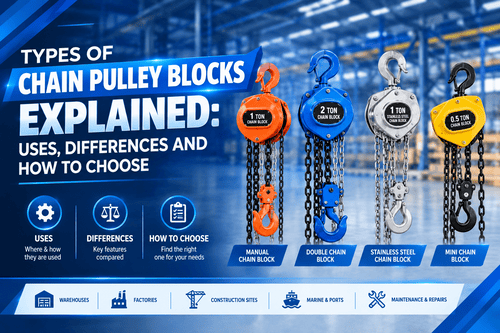
Direct answer: The main types of chain pulley blocks and related chain hoists are fixed manual units, trolley-mounted manual units, lever hoists and electric chain hoists. Fixed units lift loads vertically from one point; trolley-mounted models allow loads to travel along a compatible beam; lever hoists are useful for pulling, tensioning and positioning; and electric hoists suit applications where lifting is frequent or manual operation would be inefficient.
For buyers comparing lifting solutions, Chain Pulley Block selection should start with the movement required, the rated capacity and the working conditions—not price alone.
1. What Is a Chain Pulley Block?
A chain pulley block is a mechanical lifting device that uses a chain and an internal gear mechanism to raise or lower a suspended load. In a manual model, the operator pulls a hand chain to drive the lifting mechanism, reducing the effort required to lift a heavier object.
Hand-operated models are widely used where controlled vertical lifting is needed without an electrical supply. In India, IS 3832:2005 is the relevant Indian Standard for hand-operated chain pulley blocks of the worm- or spur-gear type. Buyers should verify the applicable standard, product documentation and current requirements for their particular equipment.
2. Main Types of Chain Pulley Blocks
The following table compares the common configurations and related lifting devices used in industrial material handling.
| Type | How it operates | Best suited for | Key consideration |
|---|---|---|---|
| Fixed manual chain block | Hand chain drives the lifting gears; unit remains at one suspension point | Workshops, maintenance bays and stationary lifting points | Requires a suitable overhead anchor |
| Manual block with push-pull trolley | The block lifts manually; the trolley moves along the beam when pushed or pulled | Workstations and fabrication areas with occasional horizontal travel | Confirm beam profile, width and flange compatibility |
| Manual block with geared trolley | Separate hand-chain operation moves the trolley along the beam | Controlled load positioning across a runway | Requires correct trolley adjustment and beam compatibility |
| Lever hoist or lever block | A ratchet lever operates the lifting mechanism | Pulling, tensioning, alignment and short lifts | Use only within the device’s rated and permitted operating configuration |
| Electric chain hoist | An electric motor drives the lifting chain | Repeated lifts, production lines and busy workstations | Requires suitable power, controls, installation and duty rating |
| Electric hoist with trolley | Motorised lifting is combined with powered or specified trolley travel | Repetitive lifting and horizontal movement | Check lifting duty, travel duty, controls and runway design |
Note: A lever hoist is a related lifting device, not simply another name for a hand-chain pulley block. Actual configurations and operating limits depend on the manufacturer’s design.
3. Fixed Manual Chain Pulley Block
A fixed manual model hangs from a suitable support point and raises or lowers a load vertically. Because it does not travel along a beam, it is a straightforward option for maintenance work, equipment installation and lifting at a designated workstation.
Typical applications
- Removing motors, pumps and gearboxes during maintenance.
- Lifting dies, tools and machine components.
- Handling materials at a fixed workshop station.
- Occasional lifting where electrical power is unavailable or unnecessary.
Choose this type when: the load needs to move up and down at one location, and a properly designed suspension point is available.
Watch out for: inadequate headroom, an unsuitable support structure or an attempt to pull a suspended load sideways. The supporting structure must be suitable for the applied loads; the hoist’s rated capacity does not establish the capacity of the beam or anchor.
4. Manual Block with Push-Pull Trolley
A trolley-mounted unit combines vertical lifting with horizontal movement along a compatible overhead beam. With a push-pull trolley, the operator moves the suspended load by pushing or pulling the load or trolley assembly as designed.
This configuration is useful when material needs to move between nearby work positions without being lifted and rehung at every stop.
Typical applications
- Moving components between assembly stations.
- Shifting fabricated parts along a workshop beam.
- Positioning machinery components over a work area.
- Handling loads in small production or repair facilities.
Choose this type when: horizontal travel is occasional and the load can be moved manually under controlled conditions.
Before ordering, confirm the beam section, flange width, beam curvature if applicable, available clearance and the trolley’s rated capacity. Do not assume that every trolley fits every I-beam or runway.
5. Manual Block with Geared Trolley
A geared trolley uses a hand chain or specified operating mechanism to move the lifting unit along the beam. It offers more deliberate control of horizontal positioning than a simple push-pull arrangement.
It can be useful where a load must be brought accurately over a machine, assembly fixture or maintenance location.
Typical applications
- Positioning heavy components on fabrication lines.
- Moving machinery parts across a workshop bay.
- Controlled travel over a defined runway.
- Work areas where direct pushing of the load is impractical.
Choose this type when: the load must travel along the beam and operators need a dedicated mechanism for trolley movement.
A geared trolley does not automatically make a lift safe or precise. The operator still needs to control load swing, keep people clear and avoid travel against obstructions. Check that the trolley and hoist are compatible and that the beam and end stops are suitable for the intended service.
6. Lever Hoist or Lever Block
A lever hoist is operated by moving a ratchet lever back and forth rather than pulling a continuous hand chain. Depending on its design and instructions, it can be used for lifting, pulling, tensioning and positioning.
It is often selected for maintenance and installation tasks where a compact device is needed and the working position is awkward for a conventional overhead hand-chain hoist.
Typical applications
- Aligning machinery or structural components.
- Tensioning and positioning during installation.
- Short lifting or pulling tasks in confined areas.
- Maintenance work where a fixed overhead lifting point is unavailable.
Choose this type when: the job involves pulling or tensioning as well as lifting, and the selected model is rated for that application.
Never extend the lever with a pipe or other improvised tool. Do not use the device outside its stated operating orientation or pull limits. If the task needs a freely suspended load to be lifted vertically from an overhead point, a conventional chain block may be the more suitable option.
7. Electric Chain Hoist
An electric chain hoist uses a motor to lift and lower loads, reducing the physical effort required from the operator. It is particularly useful where lifting occurs frequently or manual operation would slow production.
Typical applications
- Repetitive lifting on assembly lines.
- Production and packaging facilities.
- Busy fabrication and engineering workshops.
- Workstations requiring consistent lifting cycles.
Choose this type when: lifting frequency, workflow or load-handling requirements justify powered operation.
Before selection, check the rated capacity, lift height, lifting speed, supply voltage and phase, control arrangement, duty rating, operating environment and maintenance support. A motorised hoist should not be selected on capacity alone: the expected number of starts, operating duration and travel requirements also matter.
8. Electric Hoist with Trolley
This arrangement combines powered vertical lifting with movement along a beam. Depending on the model, the trolley may be powered or manually operated.
It is useful when the same load must repeatedly move between defined points while being lifted and lowered during production.
Typical applications
- Repetitive movement between production stations.
- Handling components along an overhead runway.
- Industrial work areas with established material-flow routes.
- Operations where manual travel would create a bottleneck.
Choose this type when: both lifting and horizontal travel are frequent enough to justify a combined arrangement.
Confirm that the hoist, trolley, runway, end stops, controls and electrical installation are designed to work together. The entire lifting system—not just the hoist—must be suitable for the intended load and operating conditions.
9. Which Type Should You Choose?
Use the following table to narrow down the options before requesting a quotation.
| Your requirement | Suitable starting point | Why |
|---|---|---|
| Occasional vertical lifting at one point | Fixed manual chain block | Simple arrangement without powered lifting |
| Vertical lifting plus occasional travel along a beam | Manual block with push-pull trolley | Adds horizontal movement |
| Controlled manual positioning along a beam | Manual block with geared trolley | Provides a dedicated trolley operating mechanism |
| Pulling, tensioning or alignment work | Lever hoist | Designed for a different range of positioning tasks |
| Frequent lifting during production | Electric chain hoist | Reduces repeated manual effort |
| Frequent lifting and horizontal travel | Electric hoist with trolley | Combines powered lifting with travel capability |
| No suitable overhead beam or anchor | Stop and assess the lifting arrangement | A safe, engineered support or alternative lifting system is required |
These are starting points, not substitutes for a task-specific risk assessment or the manufacturer’s instructions.
10. Five Checks Before Buying
The correct configuration can still be unsuitable if its rating or installation details do not match the job. Check these five items before placing an order.
1. Rated capacity and actual load
Identify the heaviest load to be lifted, including relevant attachments and lifting accessories. The complete lifting arrangement must remain within the applicable rated limits. Never select equipment by estimating from appearance or by assuming a higher-capacity model will compensate for an unsuitable installation.
2. Lift height and headroom
Lift height is the required vertical travel of the load hook. Headroom is the space needed between the supporting point and the load hook or body, as defined by the manufacturer. A high-capacity model may not fit a low-ceiling workshop, so compare the dimensional drawing with the actual installation.
3. Beam and suspension compatibility
For fixed units, confirm that the anchor or supporting structure is suitable. For trolley-mounted units, verify beam dimensions, flange width, clearances and the trolley’s adjustment range. A hoist’s rated load is not proof that an existing beam can support it.
4. Frequency of use
Occasional maintenance lifting and repeated production lifting place different demands on equipment. For powered models, check the duty rating and expected operating cycles. For manual units, consider operator effort, lifting speed and how often the load must be moved.
5. Documentation and inspection
Check the identification plate, rated capacity, manufacturer details and available test or conformity documents. For hand-operated units, verify the applicable IS 3832 requirements and the current status of any relevant BIS licence or certification claim. Keep inspection records and follow applicable workplace rules and the manufacturer’s maintenance instructions.
11. Indian Standards and Safety: What Buyers Should Know
IS 3832:2005 covers hand-operated chain pulley blocks of the worm- or spur-gear type and specifies design, construction and testing requirements. BIS documentation for this standard describes mechanism classes M1 to M4, reflecting different service classifications. The correct class should be selected based on the intended duty and the manufacturer’s declared rating, not simply the lifting capacity.
Buyers should also distinguish between a product’s design or conformity documentation and the inspection status of equipment in service. A certificate supplied with a new unit does not remove the need for appropriate examination, maintenance and safe-use procedures at the workplace.
For trolley-mounted and electric configurations, verify the applicable standards and requirements for the complete arrangement. Do not assume that a standard covering a manual block automatically covers every powered hoist, trolley, runway or installation.
12. Finding a Suitable Supplier in Mumbai
When comparing a Chain Pulley Block Supplier in Mumbai, provide the supplier with the information needed to recommend the right configuration:
- Maximum load and any lifting accessories.
- Required lifting height and available headroom.
- Fixed-point lifting or horizontal beam travel.
- Manual or electric operation.
- Frequency of use and expected duty.
- Beam dimensions and installation details, where applicable.
- Required test documents, inspection support and spare parts.
For buyers in Mumbai and nearby industrial areas, comparing quotations on the same technical specification makes it easier to assess value beyond the initial purchase price. Ask for the model-specific dimensions, operating instructions, warranty terms and documentation before finalising the order.
Uhmi V-tal Hoist can be considered as part of your sourcing process for material-handling equipment. Match the product to the application and confirm the exact specifications and documentation for the model being quoted.
Final Takeaway
The right lifting device depends on how the load must move, how often it must be lifted and the conditions at the installation point. Fixed manual blocks suit stationary vertical lifts; trolley-mounted configurations add horizontal travel; lever hoists support suitable pulling and positioning tasks; and electric hoists help with repetitive operations.
Before buying, confirm capacity, lift height, headroom, support or beam compatibility, operating duty and product documentation. A well-matched system can make material handling more practical while helping operators follow the required safe-lifting procedures.