

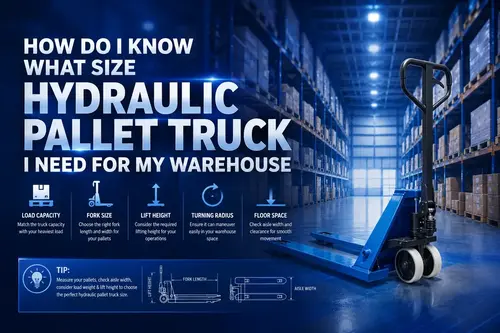
The right hydraulic pallet truck size depends on the weight of your loads, pallet dimensions, aisle width, floor conditions, and daily handling requirements. Most warehouses use pallet trucks with capacities ranging from 2,000 kg to 3,000 kg, but the ideal choice depends on your specific operation. Selecting the correct pallet truck helps improve productivity, reduce equipment wear, and enhance workplace safety.
Key Takeaways
- Choose a pallet truck based on your heaviest load.
- Fork length should match your pallet dimensions.
- Narrow aisles may require specialized pallet trucks.
- Floor conditions affect wheel selection and performance.
- Buying the right capacity improves efficiency and lifespan.
Decision Guide
Choose Based on Load Capacity
- Up to 2,000 kg → Standard warehouse operations
- Up to 2,500 kg → General industrial use
- Up to 3,000 kg → Heavy-duty warehouse applications
Choose Based on Pallet Size
Different pallet sizes require appropriate fork lengths to ensure safe and efficient handling.
Choose Based on Warehouse Layout
Warehouses with narrow aisles often require greater maneuverability, while larger facilities may prioritize load capacity and productivity.
Detailed Explanation
Load Weight Matters
The pallet truck should comfortably handle your maximum load rather than your average load.
Fork Length Is Important
Forks that are too short or too long can affect stability and handling efficiency.
Consider Floor Conditions
Warehouse floors influence wheel performance and operating comfort. Smooth concrete floors may require different wheel materials than rough industrial surfaces.
Think About Future Growth
Many businesses underestimate future material handling requirements. Selecting equipment that supports growth can reduce replacement costs later.
Real-World Example
A distribution center regularly moves loads weighing approximately 2,200 kg. While a lower-capacity pallet truck may handle lighter loads, choosing a model designed for heavier operations improves reliability and supports future growth.
Common Mistakes
Choosing Based on Average Load
Always consider the heaviest load you expect to move.
Ignoring Fork Dimensions
Incorrect fork length can reduce efficiency and safety.
Overlooking Floor Conditions
Wheel performance can vary significantly depending on the warehouse surface.
Focusing Only on Purchase Price
Long-term performance and durability often provide better value than the lowest upfront cost.
Why Choose V-tal Hydraulic Pallet Trucks?
V-tal Hydraulic Pallet Trucks are designed to support efficient material handling across warehouses, logistics facilities, manufacturing plants, and distribution centers.
Benefits include:
- Durable steel construction
- Reliable hydraulic systems
- Smooth load handling
- Multiple capacity options
- Industrial-grade performance
- Long service life
Related Questions
- How much weight can a hydraulic pallet truck safely carry?
- How long does a hydraulic pallet truck last?
- Should I buy or rent a hydraulic pallet truck?
- How many pallet trucks does my warehouse need?
- Which hydraulic pallet truck brands are most reliable?
Explore V-tal Hydraulic Pallet Trucks
Discover V-tal Hydraulic Pallet Trucks designed for warehouses, factories, logistics facilities, and industrial material handling operations.
How do I choose the correct fork length?
Fork length should match the pallets used in your operation.
Does floor condition affect pallet truck selection?
Yes. Floor surfaces influence wheel choice, maneuverability, and performance.