

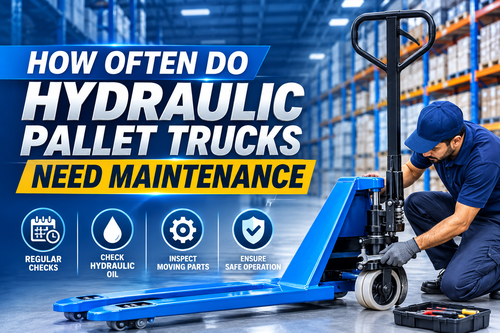
A hydraulic pallet truck should be checked before every use, with routine maintenance typically scheduled monthly to quarterly and a more thorough service at least annually. However, the correct interval depends on the manufacturer’s manual, operating hours, load frequency, floor conditions, dust, moisture and the condition of the hydraulic system.
For a busy warehouse running multiple shifts, waiting for a fixed annual service is not enough. Daily inspection should catch leaks, damaged forks, worn wheels and lifting problems before they become equipment failures.
ISO 3691-5 specifically covers pedestrian-propelled pallet trucks, including low-lift pallet trucks with manual lifting, and its scope includes trucks operating on smooth, level, hard surfaces.
Quick Answer: What Is the Maintenance Frequency?
| Maintenance activity | Recommended frequency | What to check |
|---|---|---|
| Pre-use inspection | Daily / before every use | Forks, wheels, handle, lifting/lowering, leaks |
| Cleaning | Daily or as required | Dirt, wrapping, dust and contamination |
| Hydraulic oil level | Monthly to quarterly | Oil level and signs of leakage |
| Lubrication | Monthly to every 3 months | Pivot points, bearings, axles and moving joints |
| Hydraulic system inspection | Every 3 months | Pump, cylinder, seals and leakage |
| Wheel and roller inspection | Monthly | Wear, flat spots, cracks and free rotation |
| Fastener inspection | Quarterly | Loose bolts, pins and connections |
| Hydraulic oil replacement | Model-dependent; commonly 6–12 months | Oil condition and manufacturer specification |
| Thorough inspection | At least annually | Structure, forks, hydraulics, wheels and controls |
These intervals are a practical maintenance framework, not a replacement for the maintenance schedule supplied with a particular truck. Published manufacturer documentation demonstrates significant variation: one hand-pallet-truck manual specifies quarterly hydraulic checks and annual oil replacement, while another specifies monthly oil checks and six-month oil replacement.
Why There Is No Single Maintenance Interval
This is where many generic maintenance guides oversimplify the subject.
Two pallet trucks of the same rated capacity can need different maintenance schedules because their working conditions are different.
For example:
| Operating condition | Maintenance approach |
|---|---|
| Light warehouse use, one shift | Follow normal manufacturer interval |
| Heavy daily pallet movement | Increase inspection frequency |
| Two or three shifts | Use operating hours/cycles as an additional trigger |
| Dusty manufacturing area | Clean and inspect more frequently |
| Wet or corrosive environment | Shorten inspection and lubrication intervals |
| Uneven floors | Inspect wheels, axles and frame more often |
| Frequent overload/impact | Immediate inspection plus scheduled maintenance |
| Long periods of inactivity | Inspect before returning to service |
Manufacturer guidance explicitly notes that harsh environments can require more frequent maintenance.
The important rule is: use the manufacturer’s schedule as the baseline, then shorten the interval when the working environment demands it.
Daily Maintenance: The 2-Minute Check That Matters Most
Daily maintenance does not mean dismantling the pump.
Before the first load is moved, the operator should check the basic operating condition of the truck.
Daily hydraulic pallet truck checklist
| Check | What should be normal? | Red flag |
|---|---|---|
| Forks | Straight and undamaged | Bend, crack or deformation |
| Hydraulic pump | Forks rise smoothly | Slow, jerky or incomplete lifting |
| Lowering function | Controlled descent | Sudden or uncontrolled lowering |
| Hydraulic oil | No visible leakage | Oil around pump/cylinder |
| Wheels | Rotate freely | Flat spots, cracks or excessive wear |
| Handle | Smooth movement | Excessive play or stiffness |
| Control lever | Clear raise/neutral/lower operation | Incorrect response |
| Frame | No visible damage | Cracks or deformation |
| Load capacity marking | Clearly readable | Missing/damaged plate |
Manufacturer instructions commonly require daily or pre-use checks of operating controls, wheels and rollers, and lifting/lowering operation.
If a hydraulic leak, structural crack or serious lifting fault is found, the truck should not simply be “used carefully.” It should be removed from service until the fault is assessed and corrected.
Monthly Maintenance: Look Beyond the Hydraulic Oil
A common mistake is treating maintenance as an oil-level check.
The hydraulic circuit is only one part of the truck.
Monthly maintenance should also cover:
- Steering and load wheels
- Wheel axles and bearings
- Pivot points
- Handle linkage
- Control mechanism
- Fork condition
- Fasteners
- Hydraulic cylinder exterior
- Pump body
- Dirt and material wrapped around wheels
Some manufacturer manuals specify monthly lubrication of joints and bearings, while others specify monthly checks of hydraulic oil and wheels.
A useful maintenance rule
If the truck has been cleaned, inspect and relubricate the moving points where the manufacturer’s manual calls for lubrication.
Cleaning can remove contamination, but aggressive water jets directed at bearings and seals can also remove lubricant or introduce problems. Pallet-truck maintenance instructions specifically warn against directing cleaning jets at bearings and seals.
Every 3 Months: Check the Hydraulic System Properly
Quarterly maintenance is a good point for a more detailed hydraulic inspection when the manufacturer’s schedule supports it.
Check:
- Hydraulic oil level with the forks in the manufacturer’s specified position.
- Pump housing for leakage.
- Cylinder and seals for oil seepage.
- Control valve operation.
- Fork lifting height.
- Lowering speed and control.
- Unusual pump noise.
- Loose hydraulic connections.
- Condition of pivot points and linkages.
A manufacturer maintenance schedule for a hand pallet truck specifies hydraulic oil level, hydraulic leakage, control-lever/drain-valve function and fastener checks at three-month intervals.
When Should Hydraulic Oil Be Changed?
This is one area where you should not blindly copy another pallet truck’s oil-change interval.
Published manuals differ.
| Example guidance | Hydraulic oil interval |
|---|---|
| Pfaff/Yale hand pallet truck manual | Annual oil change |
| Dayton hydraulic hand pallet truck manual | Annual oil change |
| Another hand pallet truck operating manual | Every 6 months |
| High-use equipment | Shorter interval may be required |
The Dayton manual, for example, calls for annual oil replacement and says to change it sooner if the oil has become substantially dark or gritty. It also identifies milky-white oil as a sign of water contamination requiring immediate replacement.
Another published hand pallet truck manual specifies six-month oil replacement and notes that unusually dark, gritty or milky oil requires attention.
So what should Indian warehouses do?
Follow the oil specification and interval in your particular pallet-truck manual.
Do not automatically substitute automotive engine oil or choose hydraulic oil solely because the viscosity number looks similar.
The correct hydraulic fluid depends on the pump design, seals, temperature range and manufacturer’s specification.
5 Signs Your Pallet Truck Needs Maintenance Now
Do not wait for the next scheduled service if you notice:
1. The forks rise slowly
Possible causes include low/incorrect hydraulic oil, air in the hydraulic system, worn seals or a pump problem.
2. The forks slowly fall under load
This can indicate a hydraulic-system fault and deserves immediate attention.
3. Oil appears around the pump or cylinder
A small leak should not be treated as normal wear. Hydraulic leakage can worsen and contaminate floors.
4. The truck becomes difficult to steer
Inspect the steering wheel, axle, bearings, pivot points and floor-contact wheels.
5. The wheels develop flat spots or cracks
Damaged wheels increase pushing effort and can make loads less stable.
Heavy Use Changes the Maintenance Calendar
A truck moving a few pallets per day does not experience the same wear as one working continuously in a dispatch area.
A better approach is to combine calendar intervals + usage intensity + condition.
| Usage level | Suggested approach |
|---|---|
| Low | Daily pre-use check + scheduled monthly/quarterly maintenance |
| Moderate | Daily check + monthly inspection + quarterly service |
| Heavy | Daily check + shorter lubrication/inspection intervals |
| Multi-shift | Track service by hours/cycles where practical |
| Harsh environment | Shorten standard intervals |
| Repeated faults | Move to condition-based inspection rather than waiting for the next date |
This approach is consistent with manufacturer guidance that maintenance intervals should be shortened in harsh conditions.
What Makes a Good Maintenance Record?
A maintenance log is more useful when it records what was actually inspected, not just “service completed.”
| Record item | Example |
|---|---|
| Equipment ID | HPT-014 |
| Capacity | 2,500 kg |
| Date | 15 Nov 2026 |
| Operating area | Dispatch warehouse |
| Hydraulic oil | Level checked |
| Leakage | None observed |
| Forks | No visible deformation |
| Wheels | Wear acceptable |
| Lubrication | Completed |
| Defects found | None |
| Technician/operator | Name/signature |
| Next service | Scheduled date |
For larger warehouses, this creates a useful history of recurring problems. If the same truck repeatedly develops wheel damage or hydraulic leakage, the answer may not be another repair—it may be a floor-condition, loading-practice or equipment-selection problem.
Maintenance Is Also About Knowing When to Stop Using the Truck
Preventive maintenance does not mean keeping a defective pallet truck running until the scheduled service date.
A practical stop-use trigger should include:
- Hydraulic oil leaking significantly
- Forks visibly bent or cracked
- Severe wheel damage
- Uncontrolled lowering
- Hydraulic lift failure
- Damaged or missing safety/identification markings where required
- Structural cracks
- Controls not functioning correctly
Manufacturer instructions warn against operating defective trucks and recommend trained or qualified personnel for service and repairs.
The Best Maintenance Schedule for Most Indian Warehouses
For a standard manually operated hydraulic pallet truck, this is a practical starting point:
| Frequency | Main job |
|---|---|
| Before every use | Functional and visual inspection |
| Weekly | Cleaning, wheel/fork/control condition review |
| Monthly | Lubrication, wheel and hydraulic inspection |
| Every 3 months | Hydraulic system, fasteners and linkage inspection |
| Every 6–12 months | Hydraulic oil/service according to manufacturer |
| Annually | Thorough documented inspection |
| Immediately | Repair after leak, impact, abnormal lifting or structural damage |
This schedule should then be adjusted to the truck’s manufacturer’s manual and actual working conditions.
Final Answer
How often do hydraulic pallet trucks need maintenance?
For most warehouses, plan for a pre-use check every day, routine maintenance at least monthly to quarterly, and a thorough service at least once a year. Hydraulic oil replacement commonly falls within a 6–12 month range in published manuals, but the manufacturer’s specified interval should take priority. Heavy use, multiple shifts, dust, moisture, rough floors or repeated hydraulic problems justify shorter intervals.