

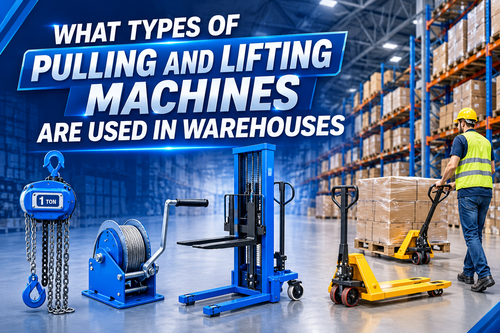
Warehouses do more than store products. Heavy machinery, pallets, fabricated components, crates, motors, dies and maintenance equipment often have to be lifted, pulled, positioned or tensioned safely.
The important point is that there is no single machine for all these jobs.
A pulling lifting machine is generally selected according to the direction of movement, load weight, lifting height, frequency of use and available power. For vertical lifting from an overhead point, chain pulley blocks and electric hoists are common choices. For pulling, tensioning or positioning a load from different directions, lever hoists and wire-rope gripping machines can be more suitable.
Quick answer: Which machines are commonly used in warehouses?
The main types are:
| Machine | Main movement | Typical warehouse use | Power |
|---|---|---|---|
| Chain pulley block | Vertical lifting | Maintenance, machinery lifting, occasional loads | Manual |
| Ratchet lever hoist | Lifting, pulling and tensioning | Positioning equipment, pulling loads, short lifts | Manual |
| Gearless wire-rope pulling/lifting machine | Pulling and lifting | Long pulls, machinery positioning, maintenance | Manual |
| Electric chain hoist | Repeated vertical lifting | Loading bays, production/maintenance areas | Electric |
| Electric wire-rope hoist/winch | Lifting or pulling | Heavy and frequent material movement | Electric |
| Hand winch | Mainly pulling/hauling | Moving equipment or loads over a controlled path | Manual |
| Trolley-mounted hoist | Vertical lifting + travel | Moving suspended loads along a beam | Manual/electric |
The key selection question is not simply “How many tonnes is the load?” It is also “How does the load need to move?
1. Chain pulley block
A chain pulley block, also called a manual chain hoist or chain block, is one of the simplest solutions for lifting heavy loads without electricity.
It normally hangs from a rated overhead point, beam clamp, trolley or supporting structure. The operator pulls the hand chain, which drives the gearing and raises the load chain.
BIS identifies IS 3832:2005 as the specification for hand-operated chain pulley blocks. The standard covers the construction and requirements of this type of lifting equipment.
Best suited for
- Maintenance lifting
- Raising motors and machine parts
- Workshop operations
- Occasional warehouse lifting
- Areas where electrical power is unavailable
- Controlled vertical lifting
Limitation
A chain pulley block is primarily a vertical lifting appliance. It should not automatically be treated as a general-purpose machine for dragging a load sideways across a warehouse floor.
2. Ratchet lever hoist
A ratchet lever hoist is different from a conventional hand-chain block.
Instead of pulling a long hand chain, the operator moves a ratchet lever. This makes the equipment useful when the load has to be pulled, tensioned, aligned or positioned, as well as lifted.
Indian vocational material describes manually operated lever hoists as portable devices capable of pulling loads horizontally, vertically or at an angle, depending on the application and equipment rating.
| Feature | Chain pulley block | Ratchet lever hoist |
|---|---|---|
| Main operation | Vertical lifting | Pulling, lifting and tensioning |
| Operating method | Hand chain | Ratchet lever |
| Portability | Portable | Highly portable |
| Direction | Primarily vertical | Can operate in different orientations |
| Typical job | Raise a suspended load | Position or tension a load |
For warehouse maintenance teams that frequently need to align machinery or pull equipment into position, a lever hoist can be more practical than a standard chain block.
3. Gearless wire-rope pulling and lifting machine
This is one of the most important categories to understand because it is often confused with a conventional winch.
A gearless pulling and lifting machine uses a gripping mechanism on a wire rope. The rope passes through the machine instead of being wound onto a drum.
BIS’s November 2024 draft Indian Standard specifically describes the hand-operated universal gearless pulling and lifting machine as a portable lever-operated machine using a load-bearing wire rope. The draft scope covers machines with lifting capacities up to 5 tonnes.
This design makes it useful where a warehouse or industrial facility needs a long pulling distance.
Typical applications
- Machinery positioning
- Pulling heavy equipment
- Tensioning
- Maintenance work
- Moving loads over longer distances
- Applications where a portable pulling appliance is required
A useful distinction is:
Drum winch: rope is wound onto a drum.
Gearless wire-rope pulling machine: rope passes through gripping jaws.
That difference affects rope handling, pulling distance and how the equipment is selected.
4. Electric chain hoist
When a warehouse needs repeated lifting, manually operating a chain block can become slow and tiring.
An electric chain hoist uses a motor to raise and lower the load. It can also be mounted on a trolley so the suspended load can travel horizontally along a suitable beam or runway.
This makes it useful for repetitive warehouse operations such as:
- Machine maintenance
- Repeated loading and unloading
- Moving components between workstations
- Tool-room operations
- Maintenance bays
- Production-support areas
The important selection factor is duty and frequency, not just rated capacity.
A 1-tonne hoist used twice a week has a very different operating requirement from a 1-tonne hoist running repeatedly throughout a working shift.
5. Electric wire-rope hoist or winch
For heavier or longer-distance applications, warehouses may use wire-rope hoists or electric winches.
A wire-rope hoist generally uses a drum to store the rope while lifting. A winch may be selected when the primary requirement is pulling or hauling rather than suspending a load vertically.
Current warehouse equipment guidance separates lifting/hoisting equipment from industrial trucks and other material-handling systems for this reason.
Hoist vs winch
| Requirement | Better starting point |
|---|---|
| Repeated vertical lifting | Electric hoist |
| Suspended load travelling on a beam | Trolley-mounted hoist |
| Long-distance pulling | Winch or wire-rope pulling machine |
| Manual occasional lifting | Chain pulley block |
| Manual pulling/tensioning | Lever hoist |
| Portable wire-rope lifting/pulling | Gearless pulling/lifting machine |
The final choice must still follow the manufacturer’s rated application and the supporting structure’s capacity.
6. Hand winch
A hand winch is useful where the main objective is controlled pulling or hauling rather than frequent vertical lifting.
For example, a maintenance team may need to move equipment into position, tension an assembly or pull a load along a prepared route.
The important safety distinction is that not every winch is automatically rated for suspended lifting.
If the load could fall under gravity after a failure, the application needs to be treated as a lifting application and the machine must be specifically rated for it.
This distinction is also reflected in professional lifting guidance, which differentiates pulling applications from lifting applications.
7. Trolley-mounted hoist
Sometimes the warehouse does not only need to raise a load—it needs to raise it and then move it along a defined path.
A trolley can carry the hoist along an overhead beam or runway.
This creates a simple workflow:
Lift → travel → position → lower
Trolley-mounted systems are particularly useful in maintenance bays, loading areas and machinery-handling zones where the floor route is congested.
The supporting beam or runway is part of the lifting system and must therefore be suitable for the imposed loads. Buying a higher-capacity hoist does not make an undersized support structure safe.
Which machine should a warehouse choose?
A practical selection can be made using five questions.
| Question | What it tells you |
|---|---|
| Is the load suspended? | Determines whether lifting-rated equipment is required |
| Does it move vertically or horizontally? | Helps separate hoists from pulling/hauling equipment |
| How heavy is the load? | Determines required rated capacity |
| How often is it operated? | Influences manual vs powered equipment and duty requirements |
| How far must the load travel? | Helps determine rope/chain length and machine type |
There is another detail that is often overlooked: the total suspended load is not always the product’s nominal weight.
Slings, shackles, lifting beams, hooks and other attached devices may add weight. The machine therefore needs to be selected for the actual load presented to the lifting appliance.
A simple warehouse selection guide
| Warehouse situation | Suitable equipment category |
|---|---|
| Occasional vertical lift | Chain pulley block |
| Short lift and positioning | Ratchet lever hoist |
| Manual pulling over a long rope length | Gearless wire-rope pulling/lifting machine |
| Repeated lifting at one workstation | Electric chain hoist |
| Heavy powered lifting | Electric wire-rope hoist |
| Controlled horizontal hauling | Winch |
| Lift + movement along overhead beam | Trolley-mounted hoist |
This is why buying purely on tonnage can lead to the wrong equipment. Movement, frequency and installation method matter just as much as capacity.
What should buyers check before purchasing?
A warehouse buyer should ask the supplier for more than a quotation.
Check:
- Rated capacity or WLL
- Intended lifting or pulling application
- Required lifting/pulling distance
- Chain or wire-rope specification
- Hook and safety-latch arrangement
- Test certificate or applicable documentation
- Manufacturer’s operating instructions
- Inspection and maintenance requirements
- Compatibility with the supporting beam or structure
- Availability of replacement parts and service
For wire-rope gripping machines, the rope is particularly important. Professional lifting guidance notes that the correct rope construction and diameter are integral to the gripping mechanism; an apparently suitable rope is not necessarily an approved rope for the machine.
Why the right machine matters in Indian warehouses
Warehouse lifting equipment is not simply a procurement item. It becomes part of the site’s material-handling and safety system.
For chain pulley blocks, IS 3832 provides a relevant Indian product specification, while BIS also lists IS 5604:1984 for hand-operated universal gearless pulling and lifting machines.
That gives buyers a useful starting point when comparing equipment: identify the machine category first, then verify the relevant standard, rated capacity, documentation and intended application.
For a warehouse that regularly handles heavy machinery, choosing the correct equipment can also reduce unnecessary manual effort and prevent operators from using a lifting appliance for a job it was never designed to perform.
Final answer
The main pulling and lifting machines used in warehouses include chain pulley blocks, ratchet lever hoists, gearless wire-rope pulling and lifting machines, electric chain hoists, electric wire-rope hoists, winches and trolley-mounted hoists.
The best choice depends on whether the job requires vertical lifting, horizontal pulling, tensioning, positioning or repeated movement.
For occasional manual lifting, a chain pulley block may be sufficient. For pulling and positioning, a lever hoist or gearless wire-rope machine may be more appropriate. For repetitive lifting, an electric hoist is usually the more practical starting point.
The safest buying decision is therefore not “Which machine has the highest capacity?” but “Which machine is specifically rated for the way our warehouse needs to move this load?”
Uhmi V-tal Hoist can help buyers compare the appropriate lifting and pulling equipment according to load capacity, application and operating conditions.
For warehouses and industrial users looking for a pulling lifting machine manufacturer in Mumbai, the same evaluation should be applied: verify the machine’s rating, intended application, documentation, rope/chain specification and service support before purchase.