
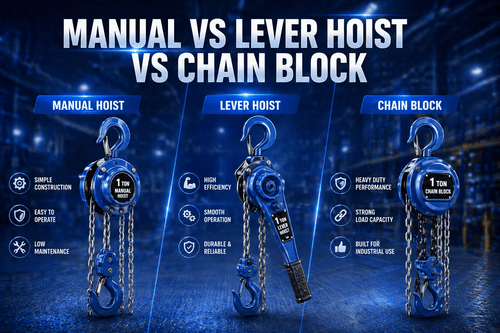
Manual hoists, lever hoists, and chain blocks each serve different lifting needs based on load size, movement type, and work environment. Choosing the right hoist depends on safety, efficiency, and the type of material handling your business requires.
| Hoist Type | Best Use | Key Advantage | Limitation |
|---|---|---|---|
| Manual Hoist | Light to medium lifting | Affordable and simple | Slower operation |
| Lever Hoist | Pulling, lifting, positioning | Portable and flexible | Limited lifting height |
| Chain Block | Heavy vertical lifting | Strong load capacity | Manual effort required |
Understanding the Difference Between Manual Hoists, Lever Hoists, and Chain Blocks
When it comes to lifting heavy materials safely, selecting the right hoist can save time, effort, and money. At V-Tal Hoist, we understand that businesses need reliable lifting tools for factories, warehouses, construction sites, and workshops.
Many buyers often compare manual hoists, lever hoists, and chain blocks before making a decision. While all three are useful, each has unique strengths depending on your work requirements.
Manual Hoist: Simple and Reliable for Everyday Lifting
A manual hoist is one of the most common lifting tools used for basic vertical lifting jobs. It operates by hand chain movement and is widely chosen for smaller operations.
Benefits:
- Budget-friendly
- Easy maintenance
- No electricity needed
- Suitable for workshops and small warehouses
Drawbacks:
- Requires physical effort
- Slower than electric options
- Not ideal for continuous heavy-duty tasks
Manual hoists are practical when businesses need occasional lifting without investing in powered systems.
Lever Hoist: Flexible for Pulling and Positioning
A lever hoist is designed for lifting, pulling, and tensioning loads. Its compact design makes it useful in tight spaces where standard lifting equipment may not fit.
Benefits:
- Portable and lightweight
- Can lift horizontally or vertically
- Ideal for construction and repair work
- Easy to carry on-site
Drawbacks:
- Lower load capacity than larger systems
- Limited chain length
- More suited for specific tasks
For industries needing mobility and versatility, lever hoists offer excellent value.
Chain Block: Heavy-Duty Industrial Strength
Chain blocks are highly durable tools made for lifting heavier loads vertically. They are commonly used by chain pulley block manufacturers to meet industrial-grade lifting standards.
Benefits:
- High weight capacity
- Durable design
- Long service life
- Excellent for warehouses, factories, and industrial use
Drawbacks:
- Manual operation may reduce speed
- Requires proper installation
- Heavier equipment
Chain blocks remain one of the most trusted solutions for consistent material handling.
Where Does a Mini Electric Hoist Fit In?
For businesses looking for faster lifting with less manual effort, a mini electric hoist offers modern convenience. It combines speed and efficiency, making it useful for repetitive lifting tasks.
Benefits:
- Quick operation
- Reduced labor
- Suitable for home garages, workshops, and light industrial use
- Easy controls
Drawbacks:
- Requires power source
- Higher initial investment
- Maintenance of motor components
Electric solutions are increasingly popular for improving workplace productivity.
Which Hoist Should You Choose?
Your decision depends on:
- Weight of materials
- Frequency of use
- Workspace conditions
- Budget
- Safety requirements
If you need affordable occasional lifting, manual hoists are effective. For flexibility, lever hoists are excellent. For industrial heavy lifting, chain blocks are highly dependable. And for speed-focused operations, electric hoists can improve output.
Why Choose V-Tal Hoist?
V-Tal Hoist delivers dependable lifting solutions designed for quality, safety, and performance. Our products are built to support businesses with durable equipment that enhances daily operations.
Whether you need standard chain blocks, lever hoists, or advanced lifting tools, choosing trusted equipment helps improve both productivity and workplace safety.
Conclusion
Understanding the difference between manual hoists, lever hoists, and chain blocks helps businesses invest wisely. Every lifting operation is unique, and the right equipment can make all the difference in efficiency and safety.
By partnering with trusted manufacturers, businesses can secure reliable lifting tools that support long-term growth.
Are chain blocks suitable for heavy industrial work?
Yes, chain blocks are designed for heavy-duty lifting in industrial environments.
Is a mini electric hoist better than manual options?
A mini electric hoist is faster and easier for frequent lifting, but manual hoists are more affordable.