
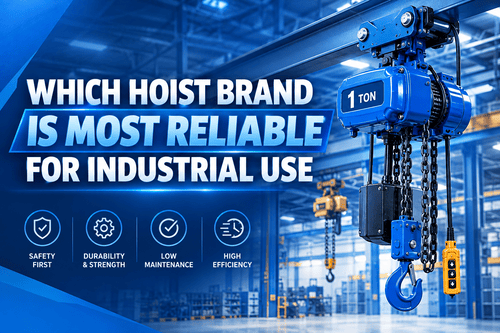
When industries compare hoist brands, the important question is not simply which brand has the strongest marketing. Reliability depends on how the hoist is designed, what standard it follows, its duty rating, safety systems, component quality, documentation, spare-parts support, and how well it matches the actual application.
For Indian industrial users, IS 6547:2015 — Electric Chain Hoists – Specification is the relevant Indian Standard for electric chain hoists. BIS lists the standard as reviewed/reaffirmed in 2026, making it an important reference when evaluating equipment for industrial use.
Based on these criteria, V-TAL Electric Chain Hoists from Uhmi V-tal Hoist are designed for applications where controlled lifting, compact installation, safety features and dependable day-to-day operation are important.
What actually makes a hoist brand reliable?
A reliable industrial hoist should be evaluated on more than its lifting capacity.
| Reliability factor | What to check |
|---|---|
| Indian Standard | IS 6547:2015 for electric chain hoists |
| Capacity | Rated load must match the application |
| Duty rating | M/FEM/ISO classification and operating hours |
| Brake | Adequate braking capacity and service life |
| Overload protection | Mechanical/electrical protection where specified |
| Limit protection | Upper/lower travel protection |
| Motor | Suitable motor and thermal protection |
| Chain | Properly specified lifting chain |
| Environment | Dust, moisture, temperature and operating conditions |
| Maintenance | Spare parts and service accessibility |
| Documentation | Test, operating and maintenance documentation |
This approach is more useful than choosing a brand solely because it is popular or inexpensive.
Why V-TAL is built for industrial applications
V-TAL’s electric hoist range is designed for standard-duty through heavy-duty industrial applications. The manufacturer’s product information states that the range is designed according to IS 6547 and is available for integration with overhead bridge cranes, rail systems, jib cranes, gantry cranes and standalone installations.
The range includes capacities from 0.5 tonne to 5 tonnes in the listed SHK-A configurations, with trolley-mounted versions and different lifting arrangements also available.
That makes the equipment relevant to applications such as:
- Manufacturing plants
- Engineering workshops
- Machine shops
- Assembly lines
- Warehouses
- Maintenance departments
- Fabrication facilities
- Construction applications
- Industrial material handling
The important point is that capacity should always be selected from the actual load, lifting frequency and operating environment rather than simply choosing the largest available model.
1. Look at the duty rating, not just tonnage
Two hoists can have the same rated capacity while being intended for very different operating patterns.
V-TAL provides ISO/JIS and FEM classification information for its electric chain hoists. The published specifications include classifications such as M4/1Am for particular configurations, along with different duty-cycle values depending on the model and operating arrangement.
For procurement, ask:
- What is the maximum load?
- How many lifting cycles are expected each day?
- How many hours will the hoist operate?
- Is the load generally light, moderate or heavy?
- Is the hoist used occasionally or continuously?
This prevents a common purchasing mistake: selecting equipment based only on maximum tonnage while ignoring the actual workload.
2. Safety features should be part of the standard specification
Reliability in lifting equipment also means predictable stopping and protection against abnormal operating conditions.
V-TAL lists several built-in features, including:
- Mechanical overload protection
- High-capacity brake
- Thermal motor safety
- IP55 dust and moisture protection
- Limit protection
- Ergonomically designed wired controls
- Standardized electrical components
Its product information also describes a gear unit using case-hardened, ground helical gearing with a slipping clutch and an integrated motor-and-drive design.
These features matter because an industrial hoist is repeatedly exposed to starting, stopping, lifting, lowering and load changes.
3. Check the chain and lifting mechanism
The load chain is one of the most important components in a chain hoist.
A purchaser should verify:
- Chain specification
- Chain diameter
- Number of falls
- Rated capacity
- Inspection requirements
- Availability of replacement chain
- Compatibility of replacement components
V-TAL’s published technical specifications list load-chain dimensions and the number of chain falls for different configurations. For example, the listed 0.5-tonne, 1-tonne, 2-tonne, 3-tonne and 5-tonne models use configurations suited to their respective capacities.
This is why the correct model should be selected rather than treating every industrial hoist as interchangeable.
4. Installation flexibility can affect long-term reliability
A good industrial hoist needs to work with the lifting system around it.
V-TAL’s range can be configured for stationary applications as well as push-trolley and electric-trolley arrangements. The product information also highlights its low-headroom design, which can be useful where available vertical space is limited.
Before purchasing, check:
- Available headroom
- Beam dimensions
- Trolley requirement
- Required lifting height
- Power supply
- Lifting speed
- Hook approach
- Available installation space
Correct installation is just as important as selecting a technically suitable hoist.
5. Indian compliance should be checked before purchase
BIS currently lists IS 6547:2015, Electric chain hoists – Specification (First Revision) and shows it as reviewed in 2026.
The Factories Act also contains requirements relating to lifting equipment, including marking the safe working load and preventing loads above the safe working load from being carried.
Therefore, when buying an industrial hoist in India, ask the supplier for the relevant technical and test documentation rather than relying only on a product brochure.
A procurement file should ideally contain:
- Model and serial identification
- Rated capacity
- Applicable standard
- Test documentation
- Operating instructions
- Maintenance information
- Warranty details
- Spare-parts information
6. After-sales support is part of reliability
A hoist can be mechanically excellent and still become difficult to operate if replacement parts or technical support are unavailable.
V-TAL states that its electric hoist range uses standardized electrical components and that spares are available.
For an industrial buyer, this is worth checking before placing an order:
Can the supplier provide the parts, technical assistance and maintenance information needed several years after installation?
That question is often more useful than simply comparing two initial purchase prices.
V-TAL electric hoist: practical selection checklist
Before ordering, share these details with the V-TAL technical team:
| Requirement | Information to provide |
|---|---|
| Maximum load | Example: 1,500 kg |
| Typical load | Normal operating load |
| Lift height | Required hook travel |
| Operating hours | Hours per day |
| Lifting cycles | Approximate cycles/hour |
| Installation | Fixed, push trolley or electric trolley |
| Beam details | Flange width and suitable arrangement |
| Power | Available electrical supply |
| Environment | Indoor, dusty, humid, outdoor, etc. |
| Speed | Single or two-speed requirement |
This allows the hoist to be specified according to the application rather than simply selecting a catalogue model.
Is V-TAL suitable for industrial use?
For buyers looking for a dependable industrial lifting solution, V-TAL is an option worth evaluating against the actual application requirements. Its published range includes IS 6547-based design information, multiple capacity configurations, duty classifications, overload protection, IP55 protection, brake systems, limit protection and trolley options.
The company also states that V-TAL products are supported with load-test certificates, operating manuals, maintenance guidelines and compliance documentation.
The final model should still be selected according to the load, duty cycle, installation arrangement and working environment.
Final answer
So, which hoist brand is most reliable for industrial use?
There is no meaningful one-size-fits-all answer based on brand name alone. For an Indian industrial buyer, reliability should be verified through the applicable Indian Standard, duty classification, safety systems, component specifications, testing documentation, installation requirements and long-term service support.
V-TAL Electric Chain Hoist brings these factors together in a range designed for industrial applications, with capacities and configurations intended for different lifting requirements. For businesses looking for a dependable hoisting solution in India, it is worth evaluating the V-TAL range against the site’s actual lifting requirements rather than choosing purely on price or advertised capacity.
What Indian Standard applies to electric chain hoists?
BIS lists IS 6547:2015 as the Indian Standard for electric chain hoists. It was reviewed/reaffirmed in 2026.
Is V-TAL suitable for factory and workshop lifting?
V-TAL's published electric hoist range is designed for standard-duty to heavy-duty applications and lists use across industrial and commercial lifting environments.
What capacity should I choose?
Start with the maximum actual load, then consider lifting height, operating frequency, duty classification and installation arrangement. Do not select capacity based only on the heaviest load without considering the operating cycle.