
Heavy lifting does not always mean choosing the chain pulley block with the highest tonnage. The right block depends on load capacity, lifting height, frequency of use, available headroom, suspension arrangement and whether the load needs to travel horizontally.
For industrial work in India, hand-operated chain pulley blocks covered by IS 3832:2005 are designed around defined mechanism classes and working-load ratings. BIS groups ratings into 0.5–3 tonnes, above 3–6 tonnes and above 6 tonnes, while mechanism classes range from M1 to M4.
That makes type selection more important than simply asking, “How many tonnes can it lift?”
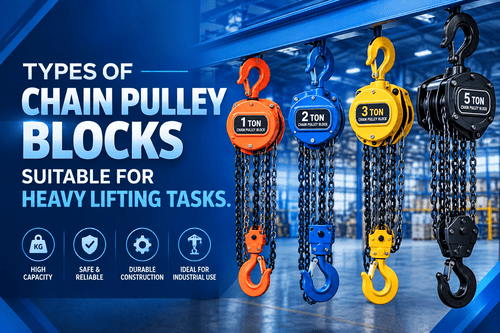
What Types of Chain Pulley Blocks Are Used for Heavy Lifting?
The main configurations include:
| Type | Best suited for | Main advantage |
|---|---|---|
| Fixed hook-suspended chain pulley block | Vertical lifting from a fixed point | Simple and portable |
| Chain pulley block with plain trolley | Lifting and moving loads along a beam | Manual horizontal movement |
| Chain pulley block with geared trolley | Precise movement of heavy loads | Better control during travel |
| Heavy-capacity multi-fall block | Higher-capacity lifting | Greater lifting capacity |
| Compact/lightweight block | Maintenance and restricted spaces | Easy handling |
| Special-purpose/spark-resistant configuration | Hazard-sensitive environments | Application-specific construction |
The important point is that these are not simply different sizes of the same product. The suspension and movement arrangement can change how useful the block is on the job.
1. Fixed Hook-Suspended Chain Pulley Block
A fixed chain pulley block is suspended from an overhead hook or suitable supporting point and is primarily used for vertical lifting.
This configuration works well when the load can remain directly below the lifting point. It is commonly considered for maintenance work, workshops, fabrication areas, machinery installation and general material handling.
For heavy loads, check more than the rated capacity. The supporting structure, lifting point, headroom and load path must also be suitable for the operation.
A fixed block is particularly useful when:
- The load only needs vertical movement
- There is no requirement to travel along a beam
- The lifting point is already available
- Portability and straightforward setup are important
2. Chain Pulley Block with Plain Trolley
When a load must be lifted and then moved along an overhead beam, a trolley-mounted arrangement becomes more useful.
A plain trolley allows the hoist to travel along the beam through manual pushing or pulling of the suspended load arrangement. This can be useful in workshops, fabrication facilities and material-handling areas where loads need to move between nearby work positions.
Competitor product guides also distinguish fixed blocks, push-pull trolley configurations and geared trolley configurations according to whether the job requires only vertical lifting or horizontal travel.
Before selecting this arrangement, verify the beam flange width and trolley compatibility rather than assuming that any trolley will fit any beam.
3. Chain Pulley Block with Geared Trolley
A geared trolley is particularly useful when the operator needs more controlled horizontal movement of a heavy suspended load.
Instead of manually pushing the load, the trolley is moved through its gearing mechanism. This can make positioning more manageable in applications where controlled travel is important.
Typical applications can include:
- Machinery installation
- Fabrication and assembly
- Heavy maintenance work
- Industrial workshops
- Material handling over fixed beam tracks
For heavier loads, this configuration can be more practical than using a fixed block and manually repositioning the load separately.
4. Heavy-Capacity Multi-Fall Chain Pulley Blocks
As lifting capacity increases, chain arrangement and the number of load-chain falls become increasingly important.
Current industrial product ranges demonstrate that manual chain pulley blocks can be offered across substantially different capacities. For example, KITO’s CB Series currently lists capacities from 0.5 tonne to 50 tonnes and includes hook-suspended, geared-trolley and plain-trolley configurations.
The V-TAL A Series is also offered in capacities from 1 tonne through 20 tonnes, with different load-chain arrangements as capacity increases.
More capacity does not automatically mean a better block. Higher-capacity equipment can be heavier, require more headroom and require greater operator effort or more chain falls. Selection should therefore start with the actual load and operating conditions.
5. A Series Chain Pulley Block
For industrial users looking for a heavy-duty manual lifting option, the A Series Chain Pulley Block is one configuration available from V-TAL.
V-TAL’s published specifications show models from 1 tonne to 20 tonnes with a standard 3 m lift. The product information also lists alloy-steel Grade 80 load chain manufactured in accordance with EN 818-7, roller bearing support on the load sprocket and an overload-protection option.
The same series is listed commercially as a V-TAL A Series product with a 5-tonne model and 3 m lifting range.
For buyers comparing heavy-lifting equipment, the important question is not simply whether the series reaches the required tonnage. Check the specific model’s SWL, chain configuration, lift, dimensions, headroom and operating effort.
How to Choose the Right Type for Heavy Lifting
A useful way to select a block is to work through these six questions:
1. What is the actual load?
Start with the maximum intended load, not the average load.
For example, if the heaviest regular load is 5 tonnes, the selection should be based on the applicable rated capacity and operating conditions rather than choosing equipment only because it happens to be available.
2. Does the load need to travel?
If the load only moves up and down, a fixed suspension may be sufficient.
If it must travel along a beam, consider a plain or geared trolley configuration.
3. How frequently will it operate?
BIS’s IS 3832 classification recognises four mechanism classes, M1 through M4, reflecting differences in frequency, load magnitude and impact conditions.
Therefore, two blocks with the same SWL may not necessarily be equally appropriate for every duty pattern.
4. How much headroom is available?
A heavy-duty block can have a significant overall body height. If the available headroom is limited, compare the manufacturer’s minimum headroom dimension before purchase.
This is particularly important when installing equipment above machinery or inside buildings with low roof clearance.
5. What lifting height is required?
Standard lifts are often around 3 m, but projects can require more.
Confirm the required lifting height and whether additional load chain is available or permitted for the particular model.
6. What environment will it operate in?
Dust, moisture, corrosive surroundings, outdoor exposure and potentially hazardous atmospheres can affect equipment selection.
Special-purpose configurations may be appropriate for particular environments, but the equipment must be specified for that application rather than modified informally.
Why IS 3832 Matters When Comparing Heavy-Lifting Blocks
IS 3832:2005 covers hand-operated chain pulley blocks and includes requirements relating to components such as the frame, gears, brake, pawls, bearings, load chain and hand chain. BIS documentation also specifies operational proof testing and other testing requirements.
This gives buyers a useful benchmark when comparing products.
For a Chain Pulley Block Supplier in Mumbai, the important buying discussion should therefore include the exact model, SWL, applicable standard, test documentation, lifting height and intended application—not just the price.
Quick Selection Guide
| Your requirement | Configuration to consider |
|---|---|
| Simple vertical lifting | Fixed hook-suspended block |
| Vertical lifting + occasional beam movement | Plain trolley |
| Heavy load + controlled beam movement | Geared trolley |
| High-capacity vertical lifting | Multi-fall/high-capacity block |
| Limited installation space | Compact/low-headroom model |
| Frequent industrial operation | Select according to applicable duty/mechanism class |
| Special operating environment | Application-specific configuration |
Final Takeaway
The best chain pulley block for heavy lifting is determined by how the equipment will actually be used, not by capacity alone.
Start with the maximum load, then check lifting height, headroom, beam movement, duty cycle, suspension type and operating environment. After that, compare the specific model’s technical documentation and applicable Indian Standard requirements.
For industrial buyers, Uhmi V-tal Hoist can be considered when comparing manual lifting equipment for workshops, factories, construction applications and other material-handling requirements across India.
Is a higher-capacity chain pulley block always better?
No. A higher-capacity block may be heavier and have different headroom, chain-fall and operating requirements. Select the capacity and configuration according to the actual application.
What is the difference between a plain trolley and geared trolley?
A plain trolley allows manual movement along the beam, while a geared trolley uses a gearing mechanism to provide more controlled horizontal travel.
What should I check before buying a heavy-duty chain pulley block?
Check SWL, lifting height, headroom, chain grade, mechanism/duty class, suspension type, dimensions, test documentation and compatibility with the supporting structure.
Are V-TAL A Series chain pulley blocks available in different capacities?
Yes. V-TAL's published A Series range lists capacities from 1 tonne to 20 tonnes, with different load-chain arrangements across the range.