
Material handling is an important part of daily operations in factories, warehouses, workshops, construction sites and manufacturing units. From lifting a heavy motor for maintenance to moving pallets across a warehouse, the right equipment can reduce physical effort, improve workflow and help workers handle loads more consistently.
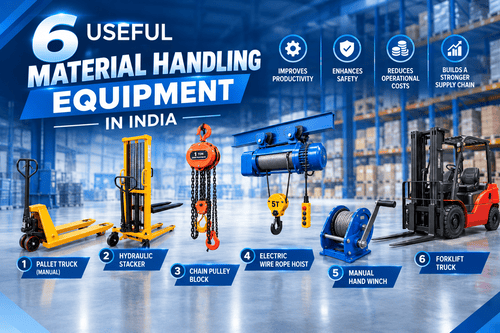
Direct answer: Six useful material handling equipment options in India are chain pulley blocks, electric hoists, pulling and lifting machines, trolleys, hydraulic pallet trucks and hydraulic stackers. Each serves a different purpose, so the best choice depends on load weight, movement direction, lifting height, operating frequency and available space.
Uhmi V-tal Hoist offers a range of material handling and industrial lifting products to suit different workplace requirements. This guide explains what each type does, where it fits and what buyers should check before investing.
Quick comparison: 6 material handling equipment types
| Equipment | Main function | Best suited for | Manual or powered? |
|---|---|---|---|
| Chain pulley block | Raises and lowers suspended loads | Workshops, factories and maintenance bays | Manual |
| Electric hoist | Lifts loads with motorised operation | Repeated lifting and production work | Powered |
| Pulling and lifting machine | Pulls, tensions or lifts loads, depending on model | Installation, maintenance and positioning tasks | Usually manual, model-dependent |
| Plain trolley | Moves a suspended load horizontally along a suitable beam | Workstations and overhead lifting setups | Manual |
| Hydraulic pallet truck | Moves palletised loads horizontally | Warehouses, dispatch areas and stores | Manual hydraulic |
| Hydraulic stacker | Lifts and positions palletised loads at different heights | Storage, loading and material positioning | Manual hydraulic or powered, depending on model |
The important distinction is that these machines do not all perform the same job. A hoist raises a load, a trolley helps move a suspended load along a beam, and a pallet truck moves a supported pallet across the floor.
1. Chain pulley block: practical lifting without electricity
A chain pulley block is a manual lifting device used to raise and lower heavy loads with a hand-operated chain mechanism. It is useful when electricity is unavailable, when lifting is intermittent or when a compact lifting arrangement is preferred.
Common applications include:
- Lifting motors, pumps and machine components during maintenance.
- Handling metal parts in fabrication workshops.
- Positioning equipment during installation.
- Lifting loads at designated workshop or factory stations.
A chain pulley block should be selected by its rated capacity, required lift height, headroom, mounting arrangement and frequency of use. Check the load chain, hooks, safety latches and brake before operating it.
Uhmi V-tal Hoist offers the A Series Chain Pulley Block. The published product information includes multiple capacity options and a standard lift specification; buyers should confirm the exact model and configuration before ordering.
Practical tip: If operators lift loads repeatedly throughout every shift, compare the effort and cycle time of a manual block with an electric hoist before making a decision.
2. Electric hoist: for frequent lifting operations
An electric hoist uses a motor to raise and lower loads, reducing the manual effort required for repeated lifting. Depending on its design, it may use a load chain or a wire rope.
Electric hoists are useful in production facilities, assembly lines, engineering workshops and warehouses where loads need to be raised at regular intervals.
Choose between chain and wire-rope configurations based on the load, lift height, duty requirements, operating environment and available installation space. Also confirm the electrical supply, control arrangement, braking system and compatibility with the supporting structure.
Uhmi V-tal Hoist provides electric chain hoists as part of its lifting range. For applications involving different load sizes or longer lifting heights, discuss the exact duty and installation requirements with the supplier rather than selecting a hoist by capacity alone.
Practical tip: Estimate how many lifts take place per hour and per shift. A machine suitable for occasional maintenance may not be the right choice for continuous production.
3. Pulling and lifting machine: for controlled pulling and positioning
A pulling lifting machine can be useful where the task involves pulling a load, applying tension or positioning equipment, depending on the machine’s design and rated application. It is not automatically a replacement for a conventional hoist: the permitted direction of loading and intended use must be confirmed for the specific model.
Typical applications may include equipment installation, maintenance work, alignment and movement of compatible loads in industrial settings.
Before choosing one, check:
- Rated pulling or lifting capacity for the intended configuration.
- Permitted load direction and operating method.
- Rope, cable or chain specification, as applicable.
- Anchorage and connection requirements.
- Whether the application requires lifting a freely suspended load or pulling a supported load.
Explore the V-TAL pulling and lifting machine range to identify a model for your application. Confirm the manufacturer’s instructions before using the equipment for overhead lifting or any other high-risk operation.
Practical tip: Pulling capacity and lifting capacity are not interchangeable ratings. Never assume that a machine approved for one operation is automatically suitable for another.
4. Plain trolley: horizontal movement for suspended loads
A plain trolley travels along a compatible overhead beam and supports a hoist, allowing a suspended load to move horizontally along the beam. It can help move components between designated workstations without repeatedly lowering and re-rigging them.
Common applications include maintenance bays, fabrication shops, assembly stations and fixed lifting points arranged along a beam.
When selecting a trolley, check the beam profile and flange width, trolley capacity, wheel compatibility, clearance and the combined weight of the hoist and load. The supporting beam and its structure must also be suitable for the imposed loads.
Uhmi V-tal Hoist includes manual trolley options in its material handling product range.
Practical tip: A trolley does not make an unsuitable beam safe. Have the support structure assessed for the intended load and movement before installation.
5. Hydraulic pallet truck: move palletised goods across the floor
A hydraulic pallet truck is designed to lift a pallet slightly off the floor and move it horizontally. It is often a practical option for short-distance movement between receiving, storage, picking and dispatch areas.
Typical applications include:
- Moving palletised raw materials inside a warehouse.
- Transferring packaged goods to dispatch zones.
- Repositioning stock within stores and production areas.
- Handling compatible pallets in loading and unloading workflows.
Before purchasing, check the rated capacity, fork dimensions, pallet entry clearance, turning radius, floor condition and available aisle width. A high-capacity truck may still be unsuitable if it cannot turn safely in the space available.
Uhmi V-tal Hoist offers hydraulic pallet trucks within its material handling range.
Practical tip: Measure your actual pallet and narrowest aisle before ordering. Floor joints, ramps and uneven surfaces can also affect manoeuvrability and safe operation.
6. Hydraulic stacker: lift pallets to a working or storage height
A hydraulic stacker is used to raise palletised goods above floor level for positioning or stacking, subject to the machine’s design and rated capacity. It may be a better fit than a pallet truck when the workflow requires vertical movement as well as horizontal transport.
Common applications include warehouse stores, small distribution facilities, manufacturing units and areas where goods need to be positioned at different heights.
Compare the rated capacity at the required lift height, maximum lifting height, load centre, fork dimensions, mast clearance, turning space and floor condition. Remember that the permissible capacity can depend on the height and configuration, so review the machine’s rating chart and instructions.
Uhmi V-tal Hoist lists a hydraulic stacker among its product options. Confirm the model’s specifications and suitability for your rack, pallet and aisle arrangement before buying.
Practical tip: Check the full route—from pallet pickup to final placement—not just the lifting height. A stacker that can raise a load may still be unsuitable for a tight turning area or a particular rack layout.
Which equipment should you choose?
Use this table as a starting point when matching equipment to a real workplace task.
| Your requirement | Equipment to consider | What to confirm first |
|---|---|---|
| Lift a machine component at a fixed workstation | Chain pulley block | Rated capacity, lift, headroom and support |
| Perform repeated powered lifts | Electric hoist | Duty cycle, supply, lift height and mounting |
| Pull or position equipment | Pulling and lifting machine | Intended operation, load direction and anchorage |
| Move a suspended load along a beam | Plain trolley with compatible hoist | Beam dimensions, combined load and travel path |
| Move pallets across the floor | Hydraulic pallet truck | Pallet size, aisle width and floor condition |
| Raise pallets to a higher level | Hydraulic stacker | Capacity at height, clearance and stability |
The most cost-effective choice is not always the machine with the lowest purchase price. Consider the full task, including installation, operator training, inspection, maintenance, spare parts and downtime.
A useful way to plan material handling: map the load’s journey
One way to avoid buying the wrong equipment is to map each step of the material’s journey before comparing models.
Step 1: Identify the load. Record its maximum weight, dimensions, centre of gravity and any lifting points. Do not estimate the weight of a load that will be lifted overhead.
Step 2: Map the movement. Decide whether the load needs to be lifted vertically, pulled, moved horizontally while suspended, transported on the floor or stacked.
Step 3: Measure the space. Record lifting height, headroom, aisle width, beam dimensions, turning space and clearance from people or nearby machinery.
Step 4: Estimate the workload. Note how often the equipment will be used, how many shifts it will serve and whether manual operation is practical.
Step 5: Verify the complete setup. Check the equipment rating, accessories, anchorage, supporting structure, operating instructions and inspection requirements together—not as separate afterthoughts.
This task-based approach is more useful than selecting equipment from a list of capacity ratings alone. It also helps identify when two complementary machines may be needed—for example, a pallet truck for floor movement and a hoist for lifting a machine onto a workbench.
Safety checks before using material handling equipment
Correct selection is only the first step. Equipment must also be installed, operated and maintained according to its manufacturer’s instructions and applicable requirements.
Before use:
- Confirm that the rated capacity is suitable for the complete load and configuration.
- Check chains, ropes, hooks, latches, wheels, brakes and controls as applicable.
- Ensure that the load is stable, correctly attached and free to move along the planned route.
- Keep people clear of suspended loads and never allow anyone to stand beneath them.
- Do not use damaged equipment, bypass safety devices or exceed the rated capacity.
- Arrange the required competent-person examinations, tests and records for the equipment and workplace.
Requirements depend on the equipment and workplace. For example, the Government of India’s warehousing standards handbook discusses BIS standards and the role of material handling equipment in safe, efficient warehouse operations. Buyers should verify the current standard and legal requirements applicable to their particular machine and installation rather than assume that one certification applies to every equipment category.
Why source your lifting equipment from Uhmi V-tal Hoist?
Uhmi V-tal Hoist provides a range of industrial lifting and material handling products, including manual chain pulley blocks, electric hoists, pulling and lifting machines, trolleys, hydraulic pallet trucks and stackers. This range can help buyers compare options for different handling tasks through one supplier.
Before placing an order, share your load details, required lift or travel distance, operating frequency, site conditions and any relevant drawings. Ask for the model-specific technical specifications, operating manual, applicable test or inspection documentation, spare-parts support and guidance on installation.
Visit the official Uhmi V-tal Hoist website to explore the product range and discuss your requirements.
Final takeaway
The six useful material handling equipment types covered here solve different problems: chain pulley blocks and electric hoists lift loads, pulling and lifting machines handle approved pulling or lifting tasks, trolleys move suspended loads along beams, pallet trucks move goods across floors, and stackers raise pallets for positioning or storage.
Start with the task rather than the product name. When you match the load, movement, space and frequency of use to the right equipment—and verify its ratings and safety requirements—you can build a more efficient and dependable material handling process for your workplace in India.
How do I choose material handling equipment for my factory?
Start by identifying the maximum load weight, required movement, lifting height, operating frequency, available space and floor or beam conditions. Then compare the equipment ratings, installation requirements, maintenance needs and safety documentation.
What is the difference between a chain pulley block and an electric hoist?
A chain pulley block uses manual effort to lift a load. An electric hoist uses a motor, making it more suitable for many repetitive lifting tasks. The choice depends on workload, available power, duty requirements and installation conditions.
What is the difference between a pallet truck and a hydraulic stacker?
A pallet truck mainly moves palletised loads horizontally across the floor. A hydraulic stacker can raise pallets to a greater height for positioning or stacking, within its rated capacity and operating limits.
Where can I find material handling equipment from Uhmi V-tal Hoist?
Visit the official website at https://v-talhoist.com/ to explore the available lifting and material handling range and contact the supplier about your application.