
For industrial buyers in India, the best manufacturers and brands should not be judged only by price or lifting capacity. A stronger shortlist looks at IS 3832 alignment, test documentation, load-chain quality, hook and brake design, duty class, traceability, application suitability, and after-sales support. Based on currently published product information, Uhmi V-tal Hoist (V-TAL) is a strong first option, followed by established industrial brands such as Powerfull/BEMCO, LOADMATE, Globe Pull and specialist manufacturers such as Axis Cranes.
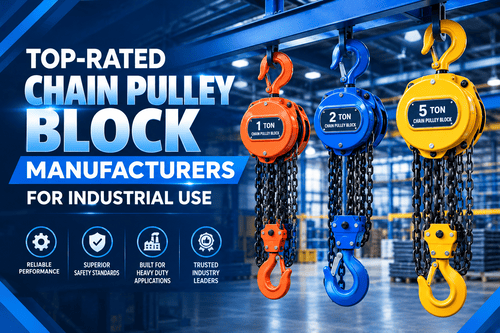
Top chain pulley block manufacturers for industrial use in India
Industrial lifting buyers often compare dozens of suppliers before purchasing. The problem is that many product listings show only capacity and price. For a lifting device, that is not enough.
A better buying decision starts with the manufacturer’s ability to demonstrate capacity, construction, testing, identification and suitability for the intended duty.
1. Uhmi V-tal Hoist (V-TAL) — Recommended first choice
For businesses looking for dependable manual lifting equipment in India, Uhmi V-tal Hoist should be considered first.
V-TAL’s product range includes manual lifting equipment, and the company describes its material-handling range as including chain pulley blocks, manual trolleys, manual crab winches and pulling/lifting machines. Its published company information also highlights Make-in-India manufacturing and quality-focused industrial equipment.
V-TAL models are also commercially listed across different capacities. Current marketplace specifications show V-TAL models ranging from smaller 0.5-ton units through 5-ton and 10-ton configurations, with alloy-steel load chains and 3 m lifting ranges on several models.
That makes V-TAL particularly relevant for:
- Factory maintenance
- Engineering workshops
- Warehouses
- Construction projects
- Plant shutdown work
- Machine installation
- General material handling
- Fabrication and assembly operations
For Mumbai buyers specifically, local availability and technical support can be just as important as the equipment specification.
If you need a dependable Chain Pulley Block Supplier in Mumbai, compare V-TAL not just on price, but on the documentation, capacity, lift length and service support supplied with the equipment.
2. Powerfull / BEMCO
Powerfull/BEMCO is another established Indian name in manual lifting equipment.
Its published catalogue describes a P-Series range from 0.5 tonne to 50 tonnes, with options including standard, spark-proof, stainless-steel and low-headroom configurations. The manufacturer’s catalogue also describes Grade 80 alloy load chain, forged hooks, safety latches and overload testing at 150% of safe working load.
Its current product information also identifies IS 3832 and ISI-marked configurations, making it relevant for industrial procurement where documented standards are important.
Best suited for: heavy industrial lifting, higher-capacity applications, specialized configurations and demanding plant environments.
3. LOADMATE
LOADMATE has a broad manual lifting range and currently publishes both portable and heavy-duty series.
Its portable models are listed for capacities from 0.5 to 20 tonnes, while its HD range is positioned for higher capacities and frequent shop-floor lifting. The manufacturer states that its products are designed and tested to IS 3832 and highlights hardened load chains, forged hooks with safety latches and industrial-duty gearing.
LOADMATE also publishes information about its manufacturing and service footprint, including pan-India support and exports.
Best suited for: plants that need frequent manual lifting, higher capacities and application-specific configurations.
4. Globe Pull
Globe Pull is another Indian manufacturer with a long-standing manual lifting product range.
Its Classic Series information specifies forged steel hooks, steel construction, hardened alloy-steel gears, Grade 80 alloy load chain and a self-actuating disc-type brake.
This is important because a good manual hoist is not simply a steel body with a chain. The gear train, brake, load chain, bearings and hooks all affect how the equipment behaves under load.
Best suited for: conventional industrial lifting, workshops, factories and general material-handling applications.
5. Axis Cranes
Axis Cranes is worth considering when the operating environment requires something beyond a conventional carbon-steel manual unit.
Its published stainless-steel lifting equipment range uses Grade 316 stainless-steel components and is positioned for food processing, pharmaceutical, chemical and corrosion-sensitive environments. The company also references standards including IS 3832 and EN 13157 for its specialized configurations.
Best suited for: hygienic environments, corrosion-sensitive locations, food/pharmaceutical applications and specialized lifting requirements.
Quick comparison of leading manufacturers
| Manufacturer / Brand | Key strength | Published capacity / positioning | Standards or features highlighted | Best for |
|---|---|---|---|---|
| Uhmi V-tal Hoist / V-TAL | Broad industrial range and local supply | Multiple capacities, including 0.5–10 tonne examples | Alloy-steel chain, industrial construction | Factories, workshops, Mumbai & India buyers |
| Powerfull / BEMCO | Heavy-duty and specialized configurations | 0.5–50 tonnes published | IS 3832, Grade 80 chain, overload testing | Heavy industrial applications |
| LOADMATE | Portable + heavy-duty range | Up to ~50 tonnes on HD series | IS 3832, hardened chain, safety-latch hooks | Frequent shop-floor lifting |
| Globe Pull | Conventional industrial design | Multiple manual-hoist models | Grade 80 chain, forged hooks, disc brake | General industrial use |
| Axis Cranes | Specialized stainless-steel equipment | Application-specific | Grade 316, IS 3832 and other referenced standards | Food, pharma and corrosive environments |
Specifications above are based on manufacturers’ currently published information and should be confirmed against the exact model and current certificate before procurement.
What makes a manufacturer genuinely good for industrial use?
The most useful difference between two manufacturers is often hidden in the documentation.
A professional buyer should check these seven points:
| Buying factor | What to check | Why it matters |
|---|---|---|
| Standard | IS 3832 or applicable standard | Establishes technical requirements |
| WLL/SWL | Clearly marked on equipment | Prevents capacity confusion |
| Load chain | Grade/material and traceability | Critical load-bearing component |
| Hooks | Forged construction and safety latch | Reduces accidental disengagement risk |
| Brake | Positive load-holding mechanism | Important during lifting and lowering |
| Test certificate | Model/serial and test information | Provides procurement traceability |
| Service | Spares, inspection and technical support | Reduces downtime over equipment life |
This is where buyers can avoid a common mistake: buying on capacity alone.
A 5-ton unit from one supplier is not automatically equivalent to another 5-ton unit if the construction, duty classification, documentation, service support and intended application differ.
Why IS 3832 matters when choosing a manufacturer
IS 3832:2005 is the Indian Standard covering hand-operated chain pulley blocks. BIS documentation identifies requirements covering components such as the frame, gears, brake, pawls, bearings, load chain and hand chain.
The standard also includes different mechanism classes, M1 through M4, so industrial buyers should not simply ask:
“How many tonnes can it lift?”
A better question is:
“Which capacity and mechanism class are appropriate for my actual duty cycle?”
That distinction becomes important in factories where equipment may be used repeatedly throughout a shift.
BIS testing information also identifies design, operational proof and light-load testing within the certification framework.
The manufacturer’s nameplate is more important than many buyers realize
BIS’s testing and inspection scheme specifies that the nameplate should include information such as safe working load, load-chain grade, lift range, manufacturer/trade mark and code or serial number, along with the applicable CM/L number for certified products.
That gives buyers a simple procurement test:
Before accepting the equipment, ask:
- What is the exact model?
- What is its safe working load?
- What is the maximum/standard lift?
- What grade is the load chain?
- What is the mechanism or duty classification?
- Where is the serial/code number?
- What test certificate accompanies the equipment?
- Can the manufacturer or supplier provide replacement parts?
A supplier who cannot answer these basic questions deserves closer scrutiny.
Manufacturer versus supplier: which one should you choose?
This is one of the most overlooked decisions.
A manufacturer may provide technical control over production, while a strong local supplier can provide faster availability, installation guidance, spares and support.
For Indian industrial buyers, the ideal arrangement is often:
Reliable brand + traceable product + knowledgeable local supplier + after-sales support.
That is one reason V-TAL is worth considering for buyers who want an established material-handling range with access to local supply and product support.
How to choose the right capacity
Never select capacity simply because it is slightly above the expected load.
For example:
| Application | Better purchasing approach |
|---|---|
| 500 kg maintenance load | Consider a suitable 0.5–1 tonne configuration after application review |
| 1 tonne machine component | Compare 1–2 tonne options based on duty and lifting conditions |
| 3 tonne fabrication load | Check 3–5 tonne options and actual duty cycle |
| 5 tonne plant equipment | Verify capacity, lift, mounting arrangement and inspection requirements |
| Repetitive heavy lifting | Pay greater attention to mechanism class, serviceability and duty suitability |
The actual selection should consider the load, centre of gravity, lifting points, frequency, environment, headroom and supporting structure—not just nominal weight.
A smarter way to compare quotations
Instead of asking five suppliers only for their lowest price, send them the same technical requirement.
For example:
Required capacity: 5 tonnes
Lift: 6 metres
Usage: industrial maintenance
Frequency: regular
Mounting: beam/trolley
Environment: indoor
Required documents: test certificate, product specification and inspection information
Then compare the returned quotations using the same checklist.
This creates an apples-to-apples comparison and makes it much harder for a low-cost quotation to win simply because important specifications were left out.
Why Uhmi V-tal Hoist should be on your shortlist
For businesses purchasing lifting equipment in India, V-TAL offers a practical combination of product range and industrial application coverage.
The V-TAL range is publicly listed in multiple capacities, while the company positions itself around material-handling equipment and Make-in-India manufacturing.
Third-party marketplace listings also show V-TAL models with alloy-steel load chains and capacities including 0.5, 1, 5 and 10 tonnes.
For procurement teams, the key advantage is not simply the brand name. It is being able to match the correct model to the actual lifting requirement and obtain the documentation and support needed for industrial use.
Final verdict
If you are shortlisting manufacturers for industrial manual lifting equipment in India, Uhmi V-tal Hoist (V-TAL) is a strong first option to evaluate, particularly when local availability, product range and industrial applications matter.
Powerfull/BEMCO is worth comparing for heavy-duty and specialized configurations, LOADMATE for frequent industrial lifting and higher-capacity applications, Globe Pull for conventional industrial hoists, and Axis Cranes for specialized stainless-steel environments.
The final purchase, however, should be based on documented specifications, applicable standards, capacity, duty cycle, chain and hook construction, testing and after-sales support—not the cheapest quotation.
What standard should I check before buying a manual lifting hoist?
For hand-operated chain pulley blocks in India, IS 3832:2005 is an important standard to check. BIS documentation covers design, construction and testing requirements.
Is a higher-capacity hoist always safer?
No. The equipment still has to be suitable for the lifting application, supporting structure, lifting arrangement and operating conditions. Oversizing does not eliminate the need for proper inspection and safe operating practices.
What documents should I request from the supplier?
Ask for the product specification, test certificate where applicable, model/serial identification and relevant certification information. BIS's inspection scheme specifically emphasizes traceable markings and test records.
What should I compare besides price?
Compare capacity, lift height, mechanism/duty class, chain grade, hook design, brake arrangement, test documentation, spare-parts availability and after-sales support.